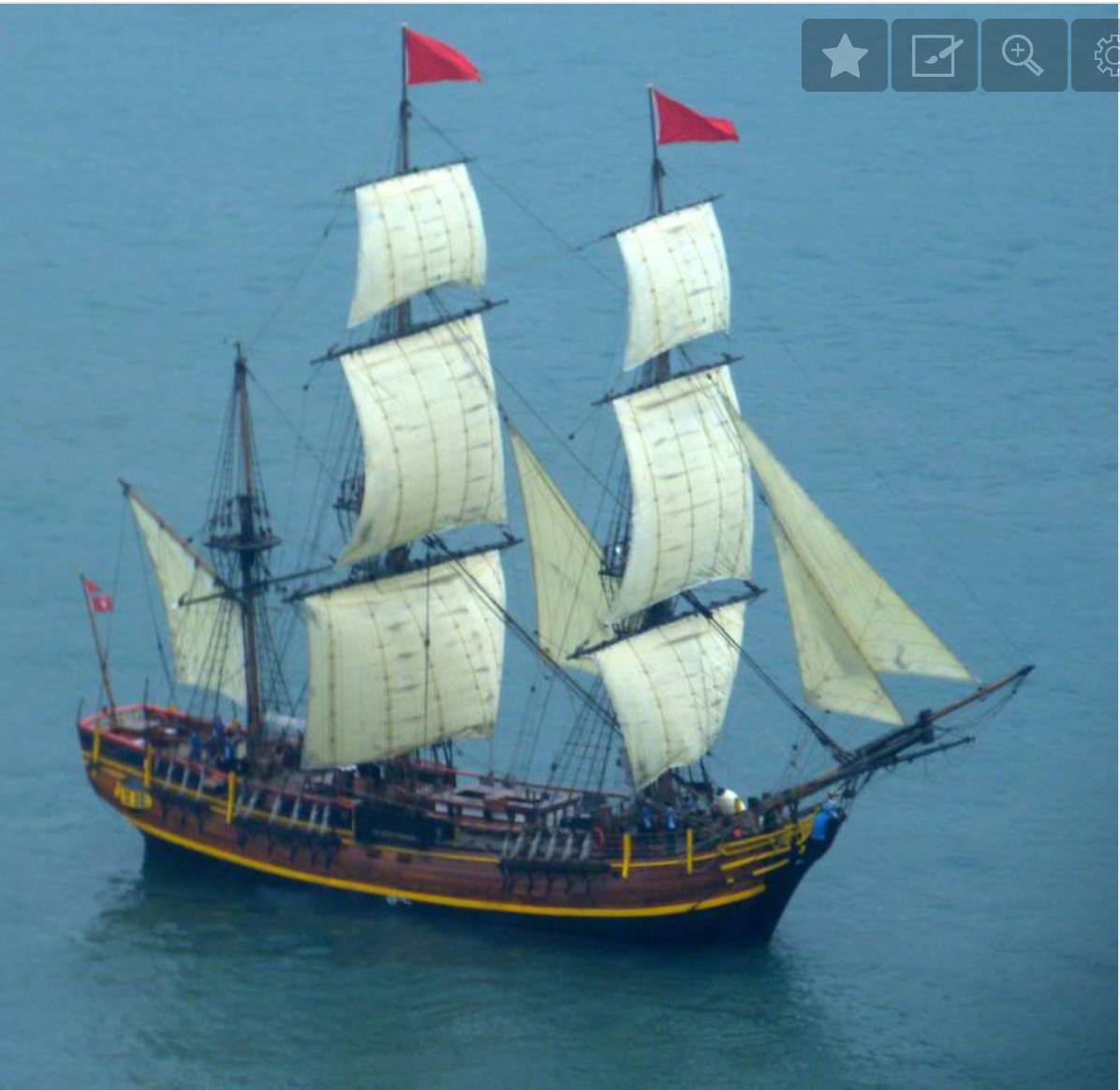
There are dozens, if not hundreds, of replica vessels out there for me to look at in the course of this blog. Often each story I find leads to another. Expo ’86 has proven to be a goldmine of heritage boatbuilding and replicas from around the world, including this second Bounty replica.
But that’s not the only connection to my other posts, this ship was built in New Zealand/Aotearoa and two of the men who worked on its rigging ended up building the R. Tucker Thompson together!
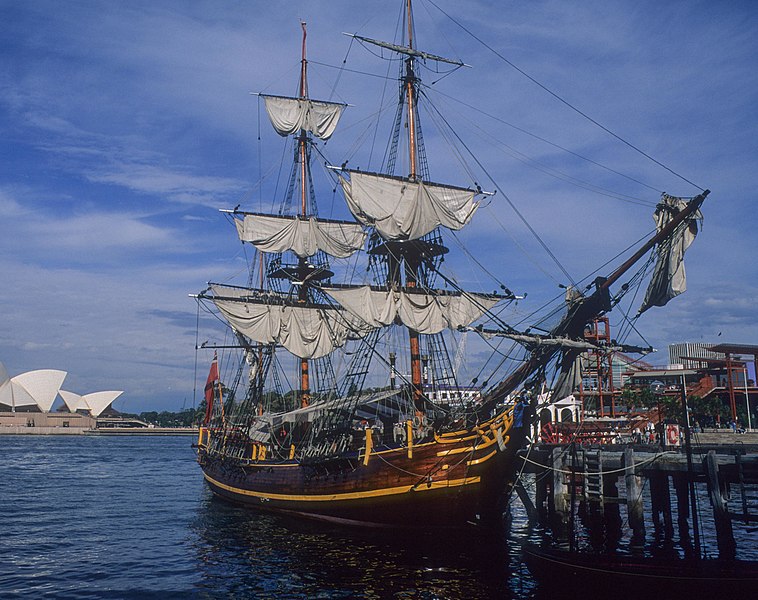
There’s many reasons to be interested in the Bounty III – it’s got an incredible story before and after its launch. The original Bounty was built by the British navy from a collier and sent on an expedition to collect breadfruit, an ignoble start before its fateful and infamous mutiny – which ended with its burning by the mutineers in 1790.
The first Bounty replica was built in my home country of Canada in Lunenburg, Nova Scotia in 1960. It used the accurate drawings, but expanded the vessel to make it easier to shoot a movie on – as it was bankrolled by MGM for the 1962 production of Mutiny on the Bounty (the one with Marlon Brando). Bounty II’s long and strange career, including being used as the set of a pornographic film, is a story in and of itself. But like many of these ships, it struggled to find a long-term role and funding for the tremendous cost of maintaining it. After several refits it was eventually lost in Hurricane Sandy in 2012. There’s a great amateur video about it here.
Instead of using the still-existing first replica, the 1984 film The Bounty commissioned a new replica built in New Zealand/Aotearoa.

Specifications
Tonnage 247*
Displacement 387 tonnes
Length
42 m (138 ft) (LOA)
30 m (98 ft) (on deck)
Beam 7 m (23 ft)
Height 33 m (108 ft)
Decks 3
Sail plan Sail area 900 m2 (9,700 sq ft)
According to Wikipedia. This vessel was significantly smaller than the first replica, but slightly larger than the original HMS Bounty.
Benefits of the Build
It wasn’t originally clear to me why the film production, backed by famous producer Dino De Laurentiis, didn’t use the first Bounty replica, which was still seaworthy at the time of this build. The original plan was to film two movies, one about the mutiny itself and the other on the aftermath with the mutineers (this never materialised). Perhaps with this in mind, they wanted a ship all to themselves for as long as they wanted. And likely, as above, they wanted a more accurate reconstruction than the comparatively gigantic predecessor, Bounty II.
I watched the trailer for the 1962 Mutiny on the Bounty and that ship is enormous!

The Bounty III was built near where I lived in New Zealand, at the Port Rd company WECO (Whangārei Engineering Company) in Whangārei, a few hours north of Auckland. Aotearoa/New Zealand was very proud of being chosen for the build, with the Prime Minister himself turning out for the launch. A small country with a small population, kiwi-land seems to punch above its weight, especially when it comes to film-making. And, like Canada, they tend to make a big deal out of such recognition.

The marketing for the build emphasized a fascinating aspect. “To reflect the international legacy of the Mutiny on the Bounty, materials for the ship were sourced from across the British Commonwealth.[5] The hull was fabricated from Australian steel, which was carvel-clad in New Zealand iroko.[5] The decking is New Zealand tānekaha.[5] The masts and spars were made of Canadian pine, with sails made from Scottish flax, and blocks of English ash and elm.[5]” (Wikipedia, citing Clarke, Malcolm; Iggulden, David (1988). Sailing Home: a pictorial record of the First Fleet Re-enactment voyage. North Ryde, NSW: Angus and Robertson.)

Jamie White, a rigger on an amazing number of square-rigged sailing ships in the last few years, cut his teeth on this replica. “HMAV Bounty is built out of steel, clad with a variety of timbers-New Zealand Tanekaha for the decks, Kauri for the ships boats, Purpleheart, Elm and Ash rigging fittings and blocks, with a 1 1/2 ton cutwater at the stem, hewn out of solid Australian Blue Gum and New Zealand Matai. In an effort to simulate the original Bounty‘s copper sheathing, metal beading has been welded onto the hull giving the appearance of copper panels when painted with a copper tinted bottom paint. Laid end to end Bounty’s halyards, sheets, braces, bunts, down hauls, clews and vangs would stretch over a phenomenal 11.5 miles.” (White, undated)
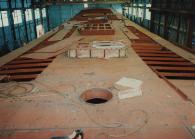
Jamie White’s website is an amazing combination of stories and photos to make anyone jealous, much like his resume as a rigger on tallships. His page on Bounty III is a heartfelt tribute to his experiences, and definitely worth a read.
White also makes sure it is understood that this vessel was built as a movie set: accurate enough above decks, but full of modern engines, amenities, and neat tricks below. “To simulate motion when shooting sequences at quiet anchorages, Bounty possesses two sets of tanks on either side of her hull and in her bow and stern. The controlled passage of water between these tanks by several large capacity pumps produces an artificial heel or roll.” (White)
To my knowledge, the Whangārei Engineering Company didn’t use their experience to make any other historical replica ships, but they certainly kept on building modern vessels. Max Avery, writing in New Zealand’s “Yachting and Power Boating” magazine, proudly stated that the vessel’s construction was a “testament to New Zealand’s ship-building industry”…full stop (and it was a steel hull covered with wood, remember). It’s clear the people involved in the build were inspired by the magic of the craft. As stated above some of the men who rigged the Bounty III later built their own replica tallship, and Jamie White went on to a long career as a rigger. I would love to delve further into the benefits of this build in terms of the passing on of heritage skills and the building of community.
There was a documentary made about the build for NZ tv as well, but I have been unable to access it from Canada.

Life After Launch
The ship was launched on December 16, 1978. The NZ Herald recalls “People started arriving at 8am and by 10am there were thousands of spectators lining the Hatea River banks, and a fleet of boats in the stream.” The Prime Minister was present, and his wife was meant to christen the ship, but apparently it slid too quickly into the water!

The same publication remarked that even after launch “She would wait two months for the fitting of her sails and sea trials before voyaging the world’s oceans as a fully working movie set.” The two movie idea had failed, and the attached director departed, but eventually this dynamite 80s film was shot by New Zealand-born director Roger Donaldson.
After filming, the vessel headed to Los Angeles for refitting, and then was convinced to attend Expo ’86 in Vancouver. Brent Leigh, who organised the Marine Plaza exhibit, notes that Expo always wanted a square-rigger to anchor their marine plaza, but the Golden Hinde was not available for the opening. Bounty III stepped in to take on the role until the English vessel arrived. (Leigh, 1987)
Shortly after that, the ship headed off to London and joined the R. Tucker Thompson and several other ships for the “First Fleet Re-enactment.” This was a project to commemorate the 1788 arrival of the first fleet of white settlers to colonise Australia – and it’s a doozy of a story itself (even if it is a bit problematic).
The Bounty III replica starred in several other productions and ran tourist cruises in Australia, but was eventually sold to a Hong Kong company. They based her in Hong Kong harbour and ran tourist excursions with her engines, before eventually selling her to a buyer in Thailand. A facebook group composed of past crew try to keep track of her now – proving that some form of community with a love of the Bounty has been sustained.
Further Thoughts
I don’t know that this example has revealed anything entirely new about heritage boat-building, but it was a thrilling story.
From a reminder of my New Zealand/Aotearoa home and their pride in a job well done to the problematic but majestic First Fleet Re-enactment (performed with little regard for the devastations of colonialism), to the long and likely frustrating search for a sustainable paying home for a beloved vessel.
It is interesting that the “Mutiny on the Bounty” story has become so universally known that it has inspired two amazing replicas. Is it so hard to imagine a third replica on the horizon? Movie studios are some of the entities with big enough pockets to build vessels of this kind, but the struggle is finding financial support for these pricey investments after the production.
For me, I think it is remarkable that those that sailed on her became so passionate that they formed a facebook group and have managed to track her after the sale from Hong Kong. It certainly speaks to the fellowship found on a vessel like this through the years.
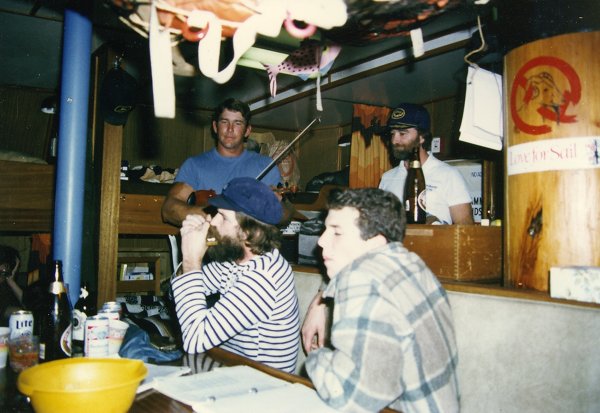
Sources
Avery, Max. “Rebuilding the Bounty” NZ Yachting and Boating Magazine (No Date, ca. 1978)
Laird, Lindy. “Whangerei and the Bounty” New Zealand Herald/Northern Advocate, 14 Dec, 2018. https://www.nzherald.co.nz/northern-advocate/news/whangarei-and-the-bounty/S6R7UFC7P4ZT3C2PQ3M5RNLYYM/
Leigh, Brent. “Preindustrial Navigation at Expo ’86” Sea History, No 43. Spring 1987.
(Retrieved January 10, 2024) “No Longer Bountiful – the careers of three Bounty ships – Part 3- Bounty replica (1979)” The Searchers. https://warsearcher.com/tag/bounty-replica-1978/
White, Jamie. (Retrieved January 10, 2024) “HMAV Bounty” TheSquareRigger.com . https://www.thesquarerigger.com/bounty.html
Clio’s Armada is a blog series Tom is writing based on his passion for heritage boatbuilding and examples he has seen of it around the world. Read about over twenty examples from the 1860s to the 2010s!


Hi I can tell more of the story of the three films that were to have been made by David Lean yes three films a trilogymy good and late friend Captain Adrian Small did the research work for Dino.
LikeLike
Oh amazing! I think I had read of only two: the mutiny; and then the experiences of the mutineers and their wives in the second. Would love to hear more!
LikeLike
Hi Tom
This is the way I had it from my friend Captain Adrian Small who if I might explain spent his working life in sailing film and replica ships he was in Passat in 1948 as an apprentice rounding Cape Horn. In the 1950s he worked with Alan Villiers on Moby Dick in 1953 managing the old schooner Brooklands and then Samuel Bronson managing the film ships Marcel B and Angiolina H making Billy Budd, Damn the Defiant, Treasure Island as ship manager at Denia in Spain, an excellent draftsman he would draw up whatever the film company needed in the way of specs for ships, sail plans and rigging his logs are a wonder to behold (now housed in the Brunel Library collections at Bristol UK). he last worked in film ships in the old Grete later sailing as Romance after the film Hawaii 1966, his life in replicas took in command Mayflower II as Mate and then Nonsuch 1970 and over an 8 year period, then Golden Hind Atlantic and Pacific voyaging, Santa Maria in Florida his final voyage was to take the NZ Bounty to Australia for the bicentennial as Adrian said “I have been to Australia twice both times in sail” he was proud of that.
Dino de Laurentis employed Adrian as researcher for the three film project that was to be 1. The Bounty, 2. The boat Journey, 3. The Pandora. I sailed out of Halifax in Sorlandet in September of 1981 on the way there I had visited New Bedford and Frigate Rose where I had a real good look at her she was in dreadful shape hull and rigging much of the rig was rotten and the hull well, I was able to put my hand in the timbers and pull out handfulls of what used to be douglas fir but was more like cotton wool. When speaking with Adrian he said he has thought she could be suitable to play Pandora in some way and would be burnt and sunk, of course they already had the NZ Bounty that was actually built upside down. He said that after working at it for three months in the end he sat in a big board room high above the back lots of Hollywood a huge room with a long table Dino at one end Adrian at the other and the accountants down both sides. Dino said “the good news is David says he will make the films the bad news is that he says he cannot be bound to a budget” the accountants said “OK don`t make the films” David Lean of course only made classics the accountants were wrong.
MGM Bounty; I had not known much of the story of her building I knew she was built by Smith and Rhuland in 1960 for the film and that she was built bigger owing to filming equipment of the day 30ft longer on deck and 6ft more in the beam and well as more lofty the original had a waterline length of 86ft the new 120ft but little else I gather she cost $750.000 to build. I have just watched a DVD of the 1962 film with all its errors the special edition double disc has three documentaries attached, on her building, her sailing and filming, a voyage down from NY to St Petersburg. In many ways better than the film itself Brando was way miscast as was Alec Guinness.
Just a little infill but might provide something of interest.
I on the other hand sailed Soren Larsen with Jim Cottier to Cape Horn in 1991 and later again in Europa and Tenacious. I have been putting together the story of my also late friend Stan Hugill the last shantyman and am still looking for photographs of some of his ships perhaps you can help with the small colonial schooners he was in that I am having trouble with let me know.
Regards Chris
LikeLiked by 1 person
Thanks so much for sharing! I definitely remembered Adrian Small’s name from my Golden Hind post but this gives such a fascinating insight into him and what it’s like to work in Hollywood.
LikeLike