

One boat leads to another, and there is a remarkable cache of content for me contained in the records of Expo ’86 in Vancouver. The Golden Hind replica of London, Phinisi Antar Bangsa from Indonesia, the York Boats I know so well from Fort Edmonton Park and others. And, of course, famous Haida artist Bill Reid’s dugout canoe Loo Taas.
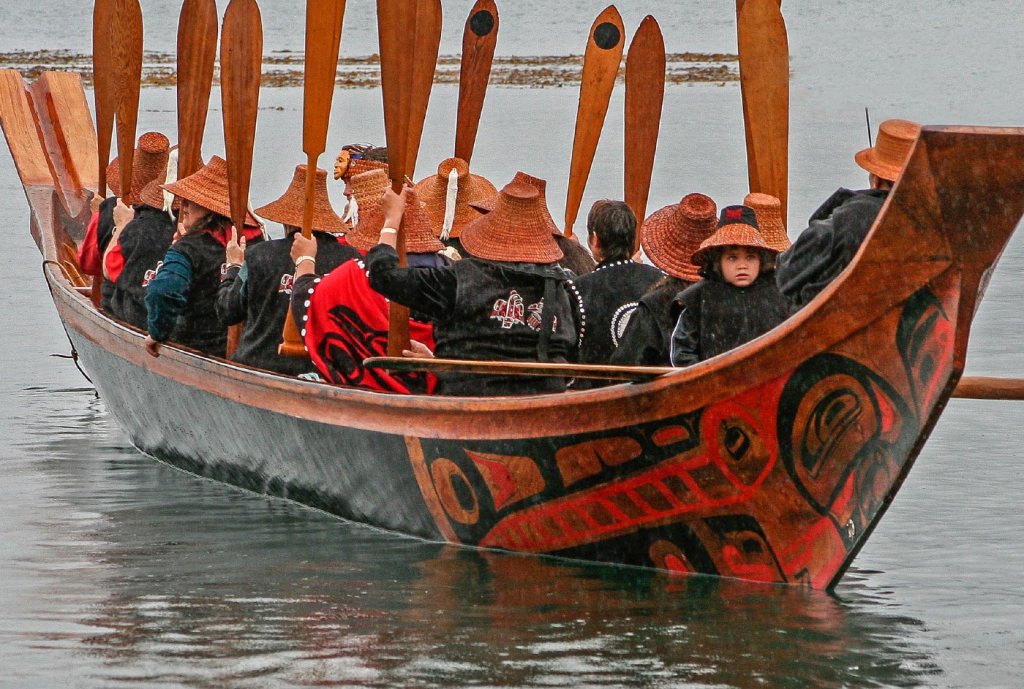
Loo Taas (pronounced loo toss) is a Haida name meaning Wave Eater, and the canoe has whales depicted on the bows to evoke this name.
I’m not even sure how to summarize Bill Reid for this blog, but I guess it would be to say he is one of Canada and the West Coast’s most recognized and celebrated First Nations artists. He has worked in a wide variety of media, and after growing up in the city of Victoria was inspired to learn and spread his people’s art – with his own stamp – after reconnecting with them in Haida Gwaii. This was in the 1940s, so by the time Expo came around he was well established and well documented. That might be why this post will contain a lot of quotes from people saying it better than I could.
“Reid decided to resurrect the art of canoe making, an epic undertaking. The traditional dugout canoe, used for fishing, transportation, and waging war, was integral to the life of native communities. The biggest canoes, up to 20 metres in length, came from Haida Gwaii. Bold in appearance and sophisticated in design, these canoes had excellent speed, capacity, and seaworthiness. However, white man’s diseases and the campaign to destroy native culture led to the end of canoe making. The last great Haida canoe was built in 1908.” (Tammemagi, 2017)

“The Haida canoe is as beautifully designed and decorated an open boat as the world has ever seen.” Bill Reid (quoted in Moire Johnston, “Homeland of the Haida,” National Geographic, July 1987, p.109)
Specifications
50ft / 15.2m
Benefits of the Build
“Her story reaches back eight hundred years to when the 73-metre-tall tree that she was carved from began to grow in Haida Gwaii. The story of Loo Taas is still unfolding today as she continues to participate in important events in the Haida community.” (McMaster, 2020)

Gerald McMaster writes that Reid’s interest was first sparked by a painting, then followed by other examples and books. He soon began making a canoe himself “in order to gain first-hand experience with the traditional processes and methods. In the early 1980s Reid started working with Haida carver Guujaaw (b.1953) and Kwakwaka’wakw carver Simon Dick (b.1951) to build a 7.5-metre inshore canoe. Shortly after came Loo Taas.” (McMaster 2020)
The connection with Expo ’86 wasn’t a coincidence. Reid knew that the theme would be transportation and said to a reporter “It seemed to me absolutely necessary to have a representative craft from the Native people who were dependent on the water as their means for getting around.” He was successful. (Reid, 2011)
The canoe was commissioned and paid for by the Bank of British Columbia, and later gifted to Skidegate, Bill Reid’s home community in Haida Gwaii, by that bank’s successor, HSBC Canada.
Bill Reid’s daughter writes that the build’s most critical step was finding the right tree. “Herb Jones was the man who didn’t give up, and after six weeks of searching the forest, found the right red cedar. It took a full day for Herb, his son Jim, and the late Larry Vogstad, to make preparations for falling the monumental cedar, which measured approximately 230 feet in height, and nine feet across at the butt.” (Reid-Stevens, 2010) These preparations included the appropriate Indigenous protocol for harvesting such a magnificent tree.
Brent Leigh was the Master of Artifacts for Expo ’86 in Vancouver. He remembered “… Canadian master carver Bill Reid led a team of five Haida Indian carvers in the construction of a 50ft canoe , carved from a 750-year-old red cedar from the Queen Charlotte Islands [now known by their traditional name as Haida Gwaii]. With a bow finished with a birdlike figurehead and painted in traditional Haida motifs, this is the first such canoe to have been built in half a century . Traditional methods were employed, the bow and stem being shaped to almost their final dimensions, and the hull sides worked to the desired thickness with hand-held tools. The hull was then filled with water into which white-hot rocks were plunged to create steam, allowing the hull to be spread open almost two feet.” (Leigh, 1987)
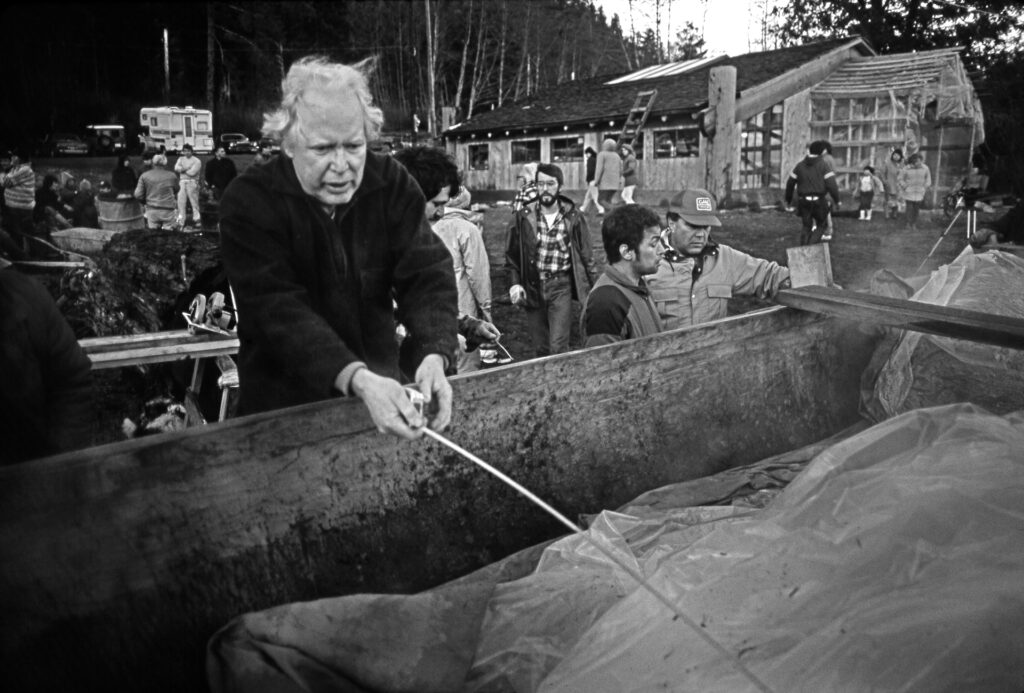
“A great deal of study and research also took place in preparation for the design of Loo Taas. Bill and a young man named Guujaaw worked together on addressing the complexities that required consideration in developing a design for a large, functional, and graceful canoe. Much of the work involved talking with elders, studying old Haida canoes held in museums, and “back-engineering.”” (Reid-Stevens, 2010)
As with most Indigenous builds I have looked at, protocol and tradition were just as important as craftsmanship and engineering. Pat Weir of Old Massett performed a ritual blessing around the canoe after steaming.
This was a clear community project as well. Not only were multiple Skidegate residents involved in the design and build, artist Sharon Hitchcock painted the finished boat.
An artist of Bill Reid’s stature, along with a platform like Expo ’86, allowed for an enormous amount of attention – including a photographer, Robert Semeniuk, hired to document the build. The subsequent voyage back up the coast helped spark a cultural revival. Thanks to Loo Taas, West coast canoe carving and journeying are in a much better place today.
Life After Launch
Oh man, you guys, this canoe has such an beautiful story after launch.
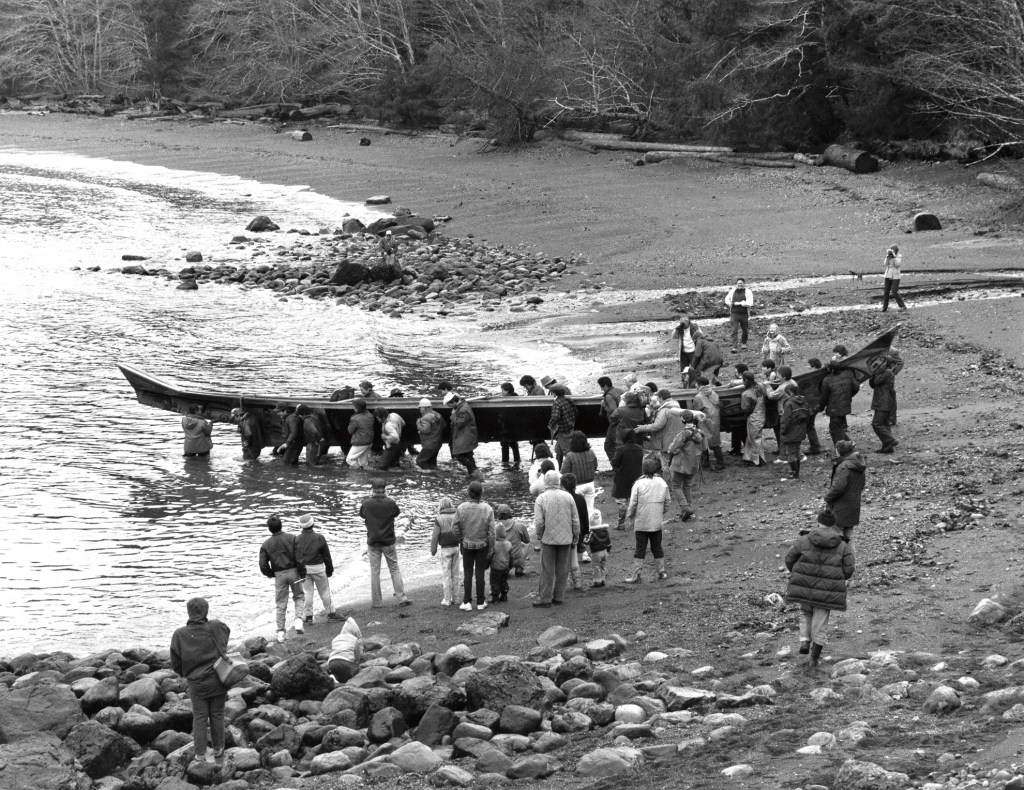
At its launch, Andy Wilson – later steersman and canoe-keeper at Skidegate – remarked “there were a huge number of people on the beach. No one except for a few elders had ever seen a Haida canoe.” (Robinson, 2011)
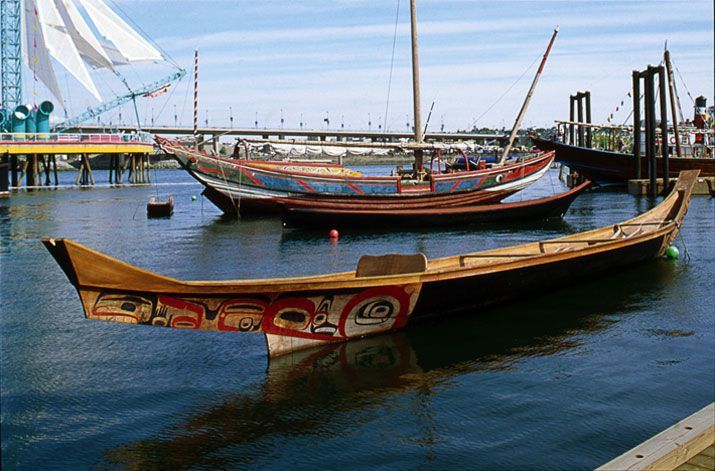
First up, it spent the summer at Expo ’86 and the Marine Plaza among boats from across Canada and the world. Then it headed back home in an epic journey that took 19 days and visited multiple communities on the way, crewed by a team of young Haida paddlers.
“The coastal First Nations held celebratory feasts and rekindled pride in their canoe heritage. Andy Wilson, one of the Haida paddlers, reminisced, “Thanks to Bill … the people up and down the coast were able to reconnect because they had to learn their songs and their dances to welcome the Haida into their big houses. So it wasn’t just one group of people reconnecting with their past, but it was a whole coast. So it was a pretty spectacular time for us … And Bill was that vital, important connection for us in the present to our ancestors in the past.” (Tammemagi, 2017)
After that, Loo Taas went to Paris. “In 1989 she was shipped to Rouen, France, and paddled by a delegation of Haida up the Seine River to be exhibited at the Musée de l’homme in Paris.” (McMaster, 2020).
In 1998, after a lengthy battle with Parkinson’s Disease, Bill Reid passed away. Loo Taas carried his ashes to his grandmother’s village in Haida Gwaii according to his wishes. Hans Tammemagi records that according to Reid, “I got more satisfaction out of the building of Loo Taas than anything I’ve ever done.”
Several copies of Loo Taas were created, some out of fibreglass amusingly called Looplex. Each was painted slightly differently. One of these now hangs at the University of BC.

The original rests in Haida Gwaii, as it should, in the Haida Heritage Centre. The centre not only displays Loo Taas and one of the Looplex duplicates, but also has a carving centre where it commissioned three new canoes of the same style.
The Haida Heritage Centre encapsulates the legacy of the canoe on its website. “The LooTaas represents more than an outstanding example of craftsmanship and art, she is the reviving of a culture, she is the reemergence of practices almost lost, she is at the center of the life and livelihood of a seafaring people.”

Further Thoughts
Some comments on a website lead me to believe that Loo Taas has recently been damaged by a mistake by staff. While this would be tragic if true, human error is always a factor and the legacy of the build and its story afterwards are still alive.

“Reid began his career believing that the social patterns that were necessary to produce great Haida art were irretrievably lost to the past. Loo Taas gifted him the opportunity to witness the contrary. Every step of making and using her asked her people to know again who they are and to enact in the present the knowledge and ways of their ancestors. As Reid proclaimed, “Western art starts with the figure—West Coast Indian art starts with the canoe.”4 Together with his Haida relations, he called forth and brought to life an animate component of Haida culture critical to the ongoing health and beauty of Haida society. Like a prayerful poem, she was conjured by Reid, but her coming into being had in mind those who truly needed her.” (McMaster, 2020).
N.B. I have decided not to italicise Loo Taas as a name, owing that italicization carries an implication of a foreign language. Since I live in B.C. in the unceded traditional territory of several First Nations, I don’t consider it appropriate to imply that Haida is at all foreign to this area. In some quotes I’ve used and seen they do italicise Loo Taas and I respect their choice.
Leigh, Brent. “Preindustrial Navigation at Expo ’86” Sea History, No 43. Spring 1987.
McMaster, Gerald. “Loo Tas, 1986” Iljuwas Bill Reid Life & Work. Art Canada Institute, 2020. (https://www.aci-iac.ca/art-books/iljuwas-bill-reid/key-works/loo-taas/)
Semeniuk, Robert. “Meeting Bill Reid and making the Lootas” Robert Semeniuk: Stories That need to be Told https://robertsemeniuk.com/meeting-bill-reid-and-making-the-lootas/ (Retrieved January 7, 2014)
Reid, Dr. Martine J. “Homeward: Bill Reid and the Haida Canoe” Bill Reid and the Haida Canoe edited by Dr. Martine J. Reid. Harbour Publishing, 2011.
Reid-Stevens, Amanda (Michael Nicoll Yahgulanaas, illus.) The Canoe He Called Loo Taas. Benjamin Brown Books, 2010.
Robinson, Michael P. “Bill Reid, Lootaas (Wave eater) and Community Development.” Bill Reid and the Haida Canoe edited by Dr. Martine J. Reid. Harbour Publishing, 2011.
Tammemagi, Hans “Bill Reid and his Canoe” Road Stories, March 24, 2017. https://roadstories.ca/bill-reid-canoe/ (Retrieved January 7, 2024)
Clio’s Armada is a blog series Tom is writing based on his passion for heritage boatbuilding and examples he has seen of it around the world. Read about over twenty examples from the 1860s to the 2010s!
 North Wind Heritage Consulting
One thought on “Clio’s Armada: Loo Taas and the Not So Lost Art of Haida Canoe Carving”