

Two of my longed for Canadian pilgrimages (besides York Factory NHS!) is the Canadian Canoe Museum and Kejimkujik National Park and National Historic Site. The former because its obvious connection to my passions of fur trade history and boat history, and the latter because of how much they value Indigenous interpretation and crafts. And that brings us to Todd Labrador and his canoe-making projects that connect the two sites.
Kejimkujik is in the heart of Nova Scotia. According to their website. “While Kejimkujik has been a popular national park for more than five decades, its importance to the Mi’kmaq people is based on millennia of ancestral history. Kejimkujik was designated a National Historic Site in 1995, making it the first National Park to have this dual status.”
For the last several years, Kejimkujik has featured public demonstrations of birchbark canoe-making by Todd Labrador, a well-known Mi’kmaw canoe-builder and artisan. I’ve chosen just one of his projects to highlight, the 2022 canoe to be featured at the Canadian Canoe Museum!
Specifications
21ft long.
Benefits of the Build
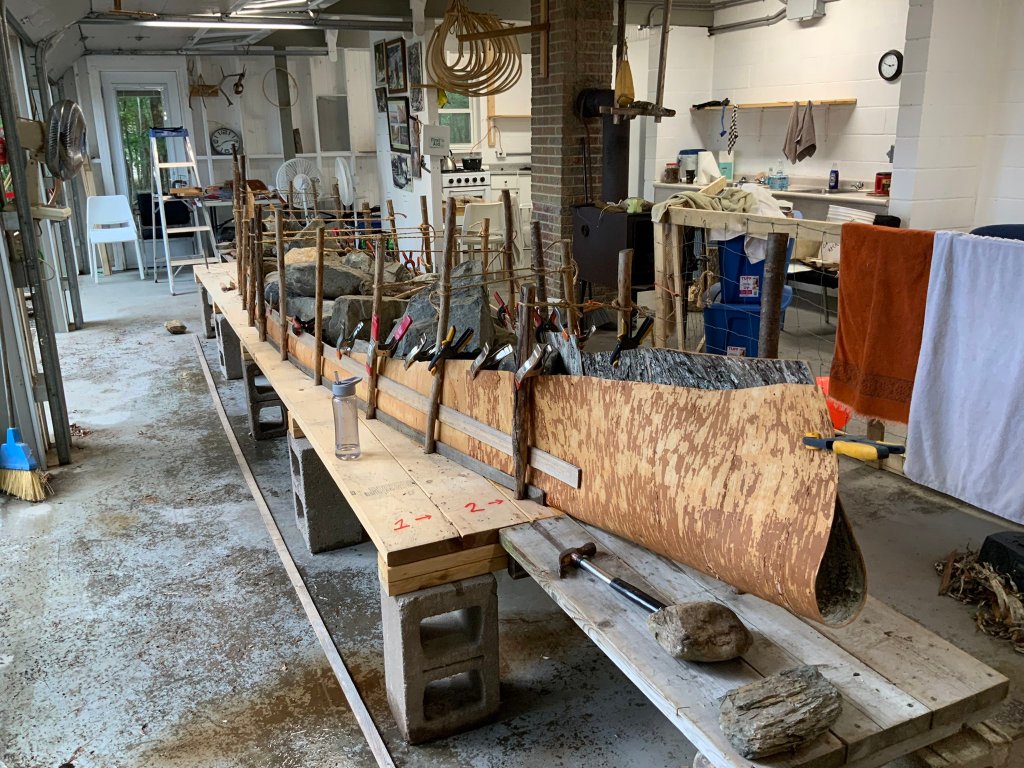
This latest birchbark canoe is a great example of the passing on of heritage skills and the creation of community. Todd led the build, but was joined by his daughter Melissa (who works for the Canadian Canoe Museum), Melissa’s children, Todd’s wife Lori, and Todd’s sister.
Todd’s builds generally happen in full view of the public, too!

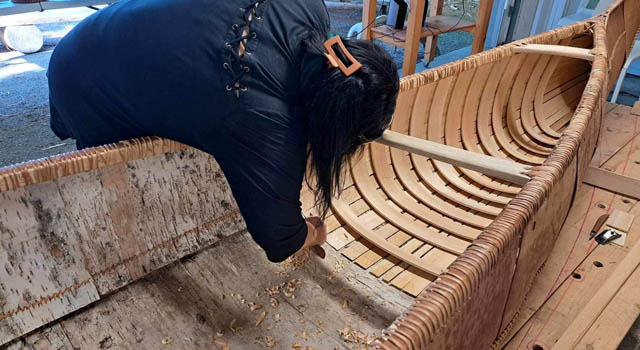
The build for the Canadian Canoe Museum was an ocean-going vessel of the Mi’kmaw style, over 20feet in length. While Indigenous nations across Turtle Island (North America) have their own canoe styles, this one is specific to the Mi’kmaq as well as having its own modern updates. A birchbark hull and sewn spruceroots is fairly standard, of course, but this iteration also uses clear cedar for the ribs (as opposed to more traditional Nova Scotia Spruce), and a variety of other hardwoods for planks, pegs, and gunwales.

Parks Canada has helpfully defined what makes Mi’kmaw canoes distinct. They are “built with one gunwale on either side of the canoe, where many other types of bark canoes, such as Malecite, Ojibway, Anishinabek, were built using two gunwales on either side: the outwale and the inwale. Their canoe ribs were forced up and in between the gunwales, whereas the Mikmaq canoe rib ends were made blunt and shoved up behind the one gunwale and between the bark and the wood.
“The Mi’kmaq canoe is also sewn with roots entirely from one end to the other, while many other canoes are sewn in approximately 2-inch intervals on the gunwale, leaving approximately a 2-inch space for the ribs.” (Parks Canada)
The birchbark cannot be harvested sustainably without killing the tree. Thus it is more important to make best use of the entire tree.
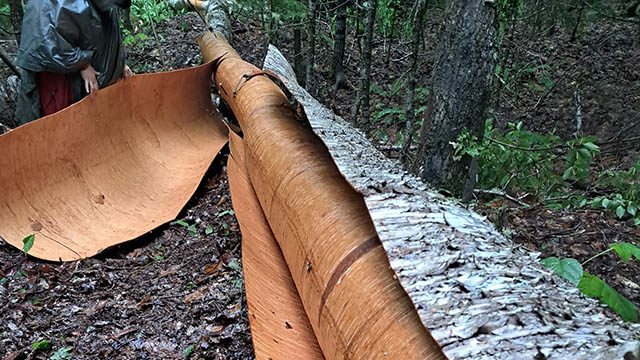
“In Todd’s experience, removing more than four to six feet of bark from a live standing tree and cutting through the cambium (the inner bark), can cause a tree to die within two years or sooner, depending on the health of the tree. Todd has taken fifteen to twenty feet of bark off a live tree and the tree died within a year and the cambium cracked and started to fall off the tree. It is best to just cut the tree down and use the wood for making paddles, thwarts, or firewood. Todd says, “We are always told not to waste and to have respect for the gifts that our Mother Earth has provided for us.”” (Parks Canada)
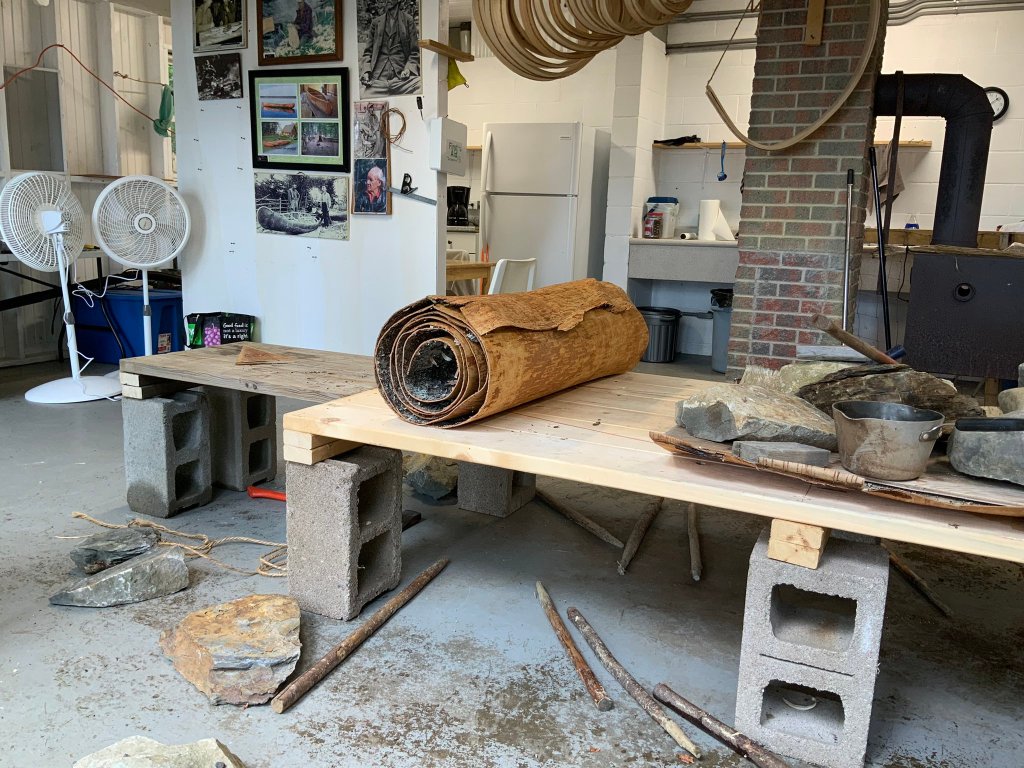
Labrador has a great deal of experience, but still consults Elders and photographs to perfect his traditional skills. Birchbark canoe-making benefits from surviving historical examples and photographs, but still evidences the cultural disruption of colonialism. Todd Labrador’s father didn’t utilise his own skills, and Todd learned some of his early techniques from a German enthusiast.
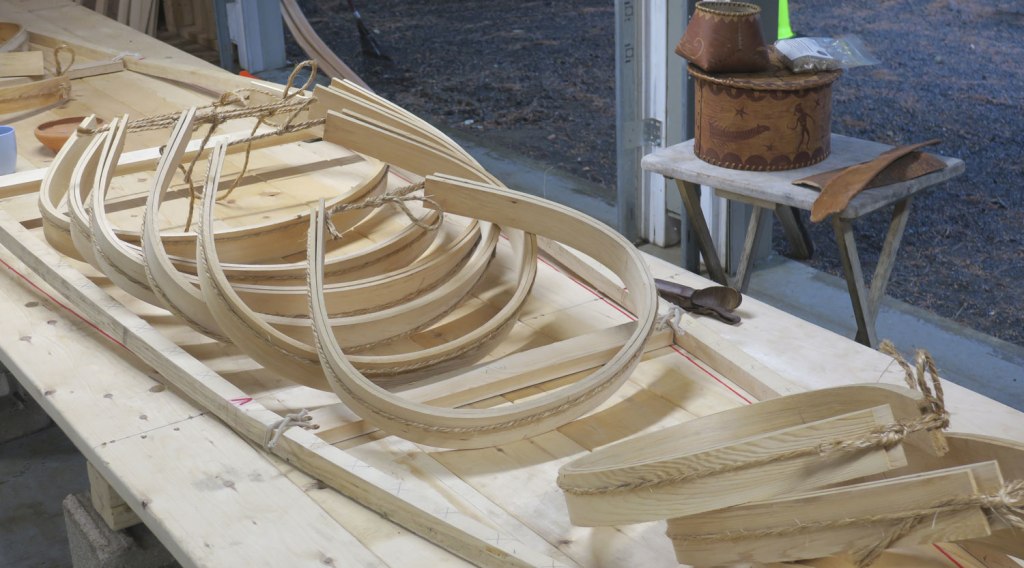
Like many Indigenous builds I have studied, Labrador goes with what works when he feels it doesn’t compromise the intent. He uses some wood that is easier to bend and work with than what was used by his ancestors, or harder and more long-lasting. And instead of boiled spruce sap (mixed with bear fat and ash), he uses modern sealant.
Life After Launch
I suppose I could have highlighted any of the canoes Todd Labrador has made in the last few years, but I’m excited about this 21-footer. It is built for the Canadian Canoe Museum (CCM), soon to be opening a new building (2024) in Peterborough, Ontario.
Th CCM’s new structure “will enable [it] to house 100 per cent of its collection in a building that meets Class A conservation standards, directly on the water, which allows for increased on-water and in-person programming while being a key cultural tourism driver in what will become a vibrant community hub on the Peterborough waterfront.” (Museum website)
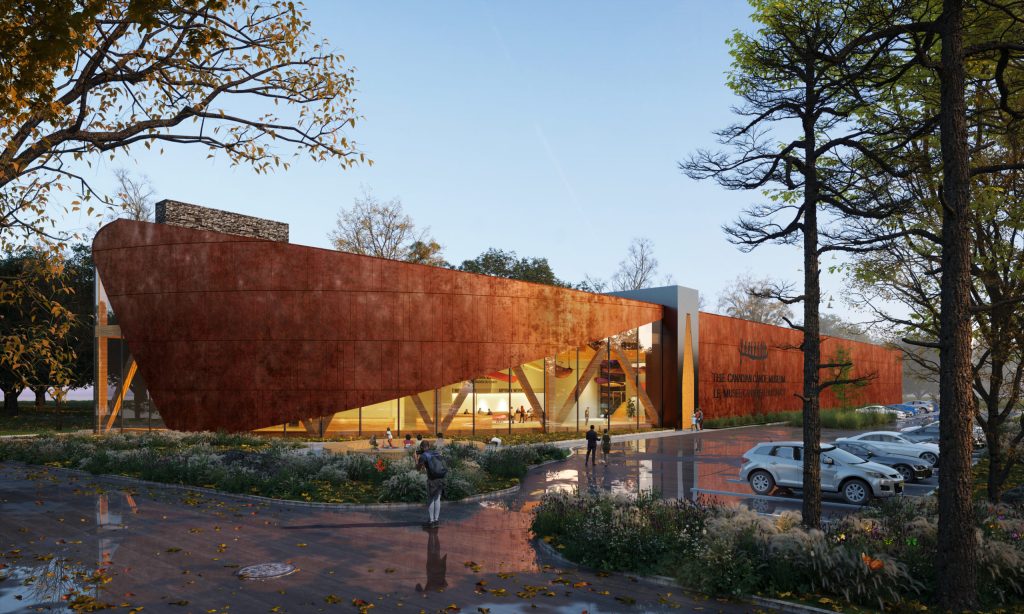
The opportunity to have a Mi’kmaw canoe on display here will enable the museum to show visitors the myriad different design and build types for canoes across Turtle Island. I can’t wait to experience this new museum and its exhibits and programmes.
While the canoe highlighted in this blog is intended for display, I didn’t want to leave readers without the sight of one of these beautiful crafts on the water.
Further Thoughts
While not an easy build, canoes (even at over 20ft) have a benefit over larger historical watercraft like tallships. They are faster and less expensive to produce – especially compared to some of the vessels we have looked at!
In the past decade, Todd Labrador has shared his skills with numerous visitors, apprentices, and family members. He has made canoes for Toronto Metropolitan University (formerly Ryerson), the Canadian Museum of History, the Bear River First Nation, and many more.
This to me is a textbook example of what heritage boatbuilding can be. A meaningful craft that commemorates a revitalised tradition, a sharing of historical skills between generations, and opportunities to create community around the process and the product.
Sources
“Traditional Mi’kmaq birch bark canoe building with Todd Labrador” Parks Canada Website, retrieved 20-12-2023. https://parks.canada.ca/pn-np/ns/kejimkujik/culture/autochtone-indigenous/canot-canoe
“Labrador family begins building a Mi’kmaq canoe for The Canadian Canoe Museum”. Canadian Canoe Museum Website, retrieved 20-12-2023. https://canoemuseum.ca/labrador-family-begins-building-a-canoe-for-the-canadian-canoe-museum/
Clio’s Armada is a blog series Tom is writing based on his passion for heritage boatbuilding and examples he has seen of it around the world. Read about over twenty examples from the 1860s to the 2010s!
 North Wind Heritage Consulting