
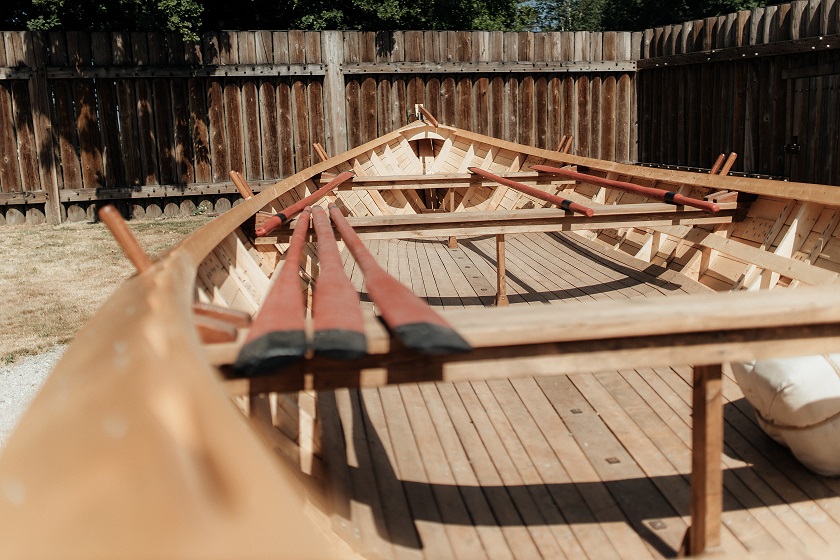
Over the Winter and Spring of 2020/2021 Fort Langley National Historic Site contracted a Métis carpenter to help complete a new bateau for display in the replica HBC post.

These bateaux were a go-to craft for the Hudson’s Bay Company tripmen in places such as British Columbia (then called the Columbia District) and northern Alberta (the Athabasca District). Built by Orkadian and Métis craftsmen (the latter often being the sons and grandsons of Orkadians) and rowed by Métis labourers, they were both an Indigenous craft and a tool of the pre-colonial mercantile empires.
In the early 19th century, the wooden-planked York boat replaced many of the birchbark canoes, due to their greater cargo carrying capacity. I was involved in rebuilding a York boat at Fort Edmonton Park – so my understanding is that flatter-bottomed Bateaux are not the same as the keeled York Boats. But they are often conflated, and I don’t pretend to be an expert. Thomas Holloway has recently written about the “Columbia Boat” and its differentiation from York Boats, but he identifies this type of boat as being distinctly clinker-built (lapstrake). I’ll refer to the Fort Langley carvel build using the generic term bateau until I’ve researched further or someone can enlighten me.
The Specifications
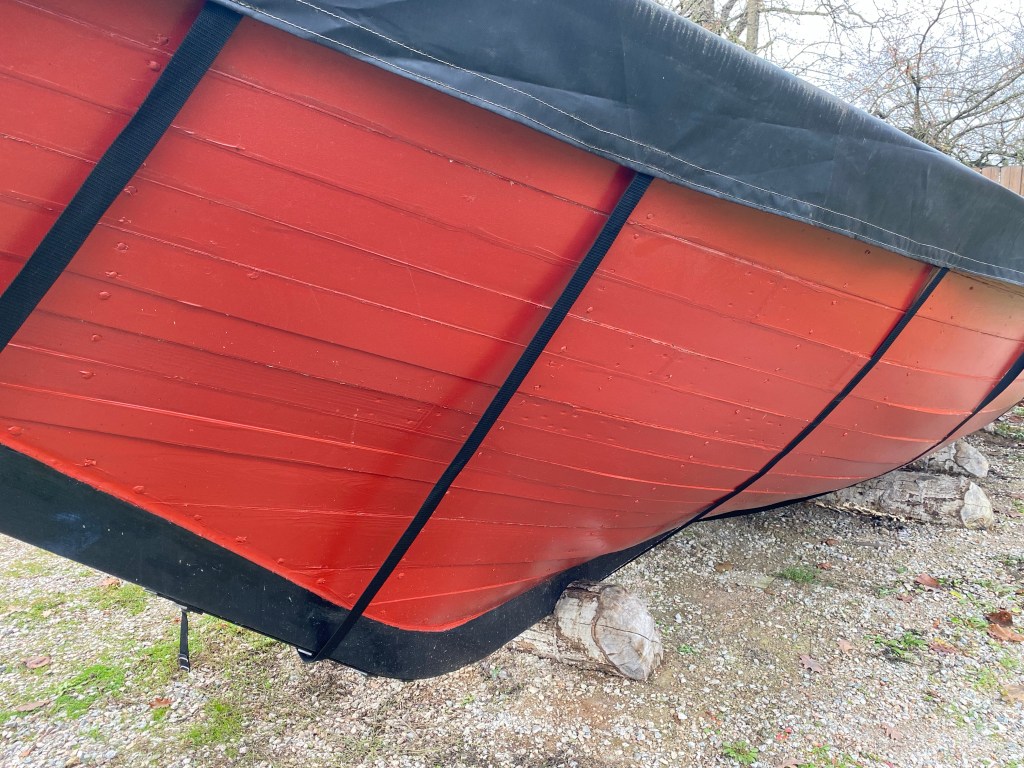
43 feet long according to this article. 13m long and 3m wide according to this one.
Benefits of the Build
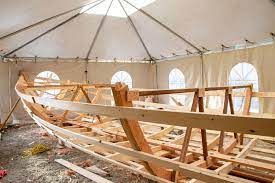
Fort Langley National Historic Site contracted Métis carpenter Pat Calihou to replace their bateau. As he told CBC “For me, it’s to commemorate [and] memorialize my family. It’s part of my heritage as a Métis. We lost a couple of generations of it. So, it’s really important to me to remember.” He worked with a friend colleague Sean Anton.
A blacksmith on site made some of the metalwork and because the boat was not intended for the water, they used iron. I know that historically York boats did use iron because they weren’t intended to last more than a season or two. Most reconstructions I know of use copper now (an increasingly expensive proposition).
The process was heavily featured in the site’s social media, and took place on site in Fort Langley, an outer part of metro Vancouver. It took place largely over the winter months, when tourism slows down (although not as much as in the snowier parts of Canada!), but staff have told me that visitors could walk right in and watch Pat at work.

It would be interesting to find our how else this process was captured. It is marvelous that at least two boatbuilders west of the Rockies, Pat and Sean, now have practical experience in the craft, but capturing and passing on these skills is an essential part of heritage boatbuilding.
Interviews with Calihou made it clear how meaningful the experience was for him. CBC reports that he has since engaged in other heritage crafts such as Red River Carts as well as childhood education.
The bateau project is a great example of heritage boatbuilding as a preservation and continuation of skills. Since there is little or no economic impetus to build wooden boats, museums and historic sites (and the governments or donors behind them) can step in and make it worthwhile. Not on the same scale, obviously, but ideally enough that the skills are passed from one generation to another.
Life after Launch
The bateau was never intended for a wet launch, but instead went on display on land at Fort Langley National Historic Site. Visitors to that site are now exposed regularly to the unique forms of Métis wooden boating and boatbuilding from the fur-trade period in this part of the world.
Métis Elder Ken Pruden smudged the boat and gave Pat a medicine bundle to keep with the boat, in keeping with traditional protocols.
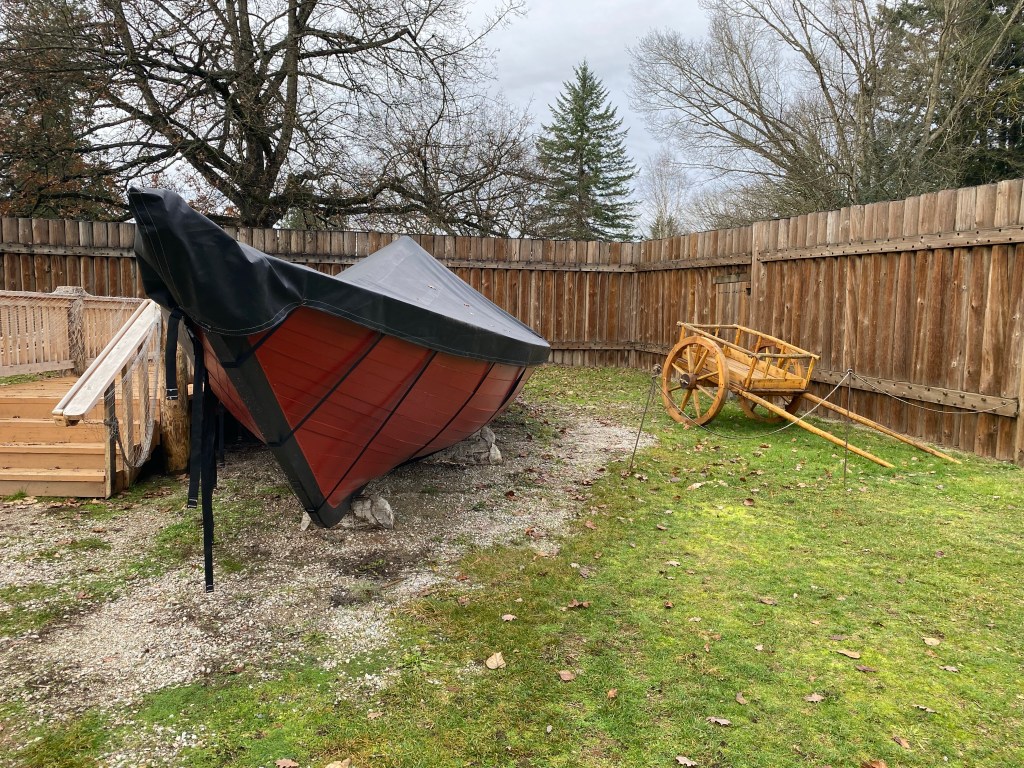
The Site echoes the importance of the river travel for Métis, First Nations, and HBC employees, as well as today.

Further Thoughts
While current battles over the meaning of Métis have brought the matter to wider attention, this Indigenous people is less well-known in Vancouver and area in my experience. Only the North-East portion of B.C. is part of the Métis homeland, so any members in Vancouver are guests on unceded territory of First Nations.
But the Métis are an essential part of Turtle Island and Canada recognises the Métis Nation as one of three Indigenous peoples. The fur trade posts were incubators for Métis culture and craft, such as bateaux, although the ethnogenesis process would continue and heighten when Métis resisted and removed themselves from the yoke of the fur-trading companies and found economic niches for themselves. Most famous of these niches is buffalo hunting, but river-travel and river-guiding is a significant part of Métis history as well.
Fittingly then, the Fort Langley bateau also became part of a virtual exhibit on Métis culture in BC. The more opportunities to recognise and spread the story of this Indigenous people and their crafts, the better.
Clio’s Armada is a blog series Tom is writing based on his passion for heritage boatbuilding and examples he has seen of it around the world. Read about over twenty examples from the 1860s to the 2010s!
 North Wind Heritage Consulting
One thought on “Clio’s Armada: Métis Bateau and Fort Langley National Historic Site”