
Tom Long, 2025
This blog reflects on mixed descent Indigenous representation in visual pop culture (movies, tv, video games, comics).
Adoption is a legitimate way for all families and nations to accept new members. Many Indigenous nations have long traditions of this practice, allowing them to adopt and absorb new persons and therefore create kinship ties to secure alliances and end hostilities, among other benefits. Adoption, however, creates problems for modern restrictive views on nationhood, and also creates dangerous opportunities for appropriation and pretendianism. In pop culture it often leads to the “white saviour” trope.
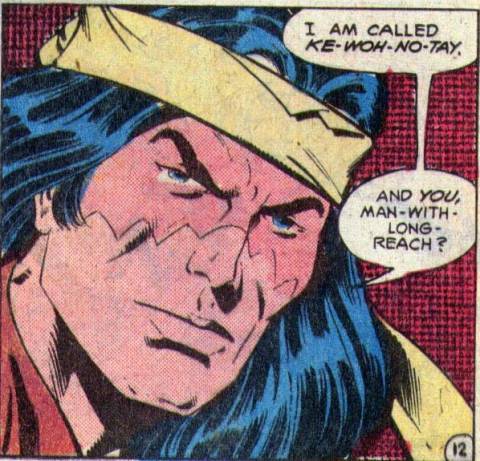
Firehair and Speedy from DC Comics
Firehair and Speedy seem like two sides of the same coin. While Speedy was raised by the Dine (Navajo), he chose to live as a white person in a non Indigenous society. Firehair was adopted by the Nitsitapii (Blackfoot Speaking Peoples) and chose to stay and identify himself as one of them. A completely valid option that nonetheless is socially and legally fraught.

The character of Firehair from DC Comics’ Showcase in 1969 was a white person adopted into the Nitsitapii (Blackfoot) after an (eyeroll) “massacre.” Later, rejected by both his First Nations and his white contemporaries, he became a wandering hero of the Old West.
He was created by the inimitable Joe Kubert who is also the artist featured in the advertisement pictured.
Roy Harper was introduced as Green Arrow’s sidekick, later becoming a hero in his own right known best as Speedy.
He was created in 1941 by writer Mort Wiesenger and artist George Papp. The art featured is from Rick Mays.

Speedy was orphaned son of a park ranger who was adopted into a Dine (Navajo) band and taught archery. In most of his stories, he honours his Indigenous upbringing, but identifies as white.
DC Comics were very interested in this type of story, adding a third “raised by natives” hero in 1977 in Weird Western Tales. Brian Savage,was white man adopted by Kiowa after they (eyeroll) killed his mother. He starred in some typical western stories, being known by the name “Scalphunter,” which I hope I don’t need to tell you is…not great.
He was created by Sergio Aragones and Joe Orlando, though the first issues were scripted by Michael Fleisher

Tv Tropes sums up the “Raised by Natives” trope that Firehair and Brian Savage reflect, in addition to the “Mighty Whitey” trope.
” A common variant is to have the kid be Mighty Whitey raised to be a Noble Savage, uniting the most powerful traits of both (being mighty, white, noble, and a savage!) and getting rid of his invading relatives. More seriously, this can be used to give western audiences (the orphan is usually a Caucasian in a non-European continent) someone to relate to who can defend the natives of the place from “evil” Caucasians.” – TV Tropes
White or non-Indigenous youth being raised by First Nations is a well know historical tradition. Roy Harper and his DC Comics fellows may be partially based on Herman Lehman, who became known as En Da, as well as Montechena. Lehman and figures like him could become valuable intermediaries, such as in the case of Pierre Radisson.
There is a gender dynamic as well. A girl adopted by First Nations was often a thing to be feared in media. Natalie Woods’ character Debbie from the 1956 film The Searchers is kidnaped by Comanche early on and the story revolves around trying to rescue her – although John Wayne’s character seems expected to kill her instead. The possibility of her being married to a Native man (referred to demeaningly as a ‘buck’) horrifies him. If it were a man married to a native woman the response would be different.

These adoptees may be culturally mixed, but their Indigeneity is a fraught matter. Adoption and other kinship traditions to incorporate outsiders into native nations are often controlled by non Indigenous colonisers who prefer blood quantum as a measure. You could say that Indigenous communities are allowed by the colonial system to be nations, but no longer allowed to be states.
Nonetheless, adoption into Indigenous communities is not a simple matter. The flip side is the described by mixedblood academic Louis Owens when speaking specifically of the 1990 Kevin Costner film Dances with Wolves.
“The crucial Euramerican fantasy of being inseminated with Indianness, of absorbing and appropriating everything of value in the indigenous world as a prelude to eradicating and replacing the actual native….Like a psychic vampire, the Costner character will for this moment on in the film become more and more “Indian” until, in the final absurdity, he is a better Indian than the Indians themselves….When Dunbar has absorbed everything possible from the fragile Lakota band, the Indians become disposable. It is time then to erase and replace the Indian – the ultimate fantasy of the colonizer come true.” – Owens (1998). Pg 123
Natty Bumpo, Little Big Man, John J. Dunbar, and other Screen Depictions of “Raised by Natives.”
Adoptees are frequently featured in fiction and in films such as The Searchers and Little Big Man. Sometimes the trope is used so that one can have a white protagonist with Indigenous cache, such as in 1992’s Last of the Mohicans. They are culturally mixed: just native enough to be cool, but not so much that they’re so different from the mainstream audience.

The reality is that a movie with Uncas’ actor Eric Schweig as the main character would not be quite the same. Schweig is mixed descent himself, (Inuit, Portuguese, German, and Senegalese). But there are other considerations besides marketability.

Jake Sully in 2009’s Avatar is able to use science fiction to literally become an Indigenous person (or the thinly veiled alien equivalent). He then swiftly becomes better at everything the Na’vi do than they are, while also retaining all of his “White” skills as well. Ugh. He gets to live the fantasy of absorbing Indigeneity and reinforces White Supremacy at the same time.

1990’s Dances with Wolves also doubles down with two “raised by natives” white characters who can end up together so there is no possible miscegenation. The fantasy of possessing Indigeneity is better the less it is tied to ethnicity, as neatly stated in this exchange between a white character and a mixed one from the 1991 film At Play in the Fields of the Lord.
Martin Quarrier: Let me just tell you, personally, as an American I would be very proud to have Indian blood! Yeah, I believe there would be many Americans proud to have it!
Lewis Moon: Oh they would huh?
Martin Quarrier: Yeah.
Lewis Moon: Just how much Indian blood would Americans be proud to have?

Lewis Moon is played by Tom Berenger, who is not mixed himself.
Mixedblood author Louis Owens comes back to tell us how these tropes fit nicely into the ultimate one: that of the Vanishing Indian.
“Once it is assumed that the Indian neither threatens white civilization nor possesses a meaningful claim to property, America is finally able to look at the indigenous American sympathetically. The Indian then becomes a historical artifact of distinct value. The role of the white man at that stage is to learn as much as possible from the Indian – that is, to become as much as possible like the Indian without being the Indian – before the race of Native Americans disappears with the setting sun.” Owens (1998). Pg 110.
Adoption of non-Indigenous or extranational persons into First Nations is a longstanding tradition – but it is not without its issues. Pop culture tends to look at only the latter – although it often seems oblivious to the problem.
I’ll just add briefly that looking critically at films like The Searchers or Last of the Mohicans doesn’t mean I don’t enjoy them. (But James Cameron’s Avatar is especially egregious and can go to hell).
Do you have another good example of adoptions or appropriation in movies, film, or comic-books? Tell me about it in the comments!
MixedMedia is a blog series Tom is writing based on explorations of his identity as a Métis person, a mixed person, and an avid consumer of pop culture.
Sources
Owens, Louis. Mixedblood Messages: Literature, Film, Family, Place. University of Oklahoma Press, 1998.
Mighty Whitey. (n.d.). In TVTropes. Retrieved November 5, 2025, from https://tvtropes.org/pmwiki/pmwiki.php/Main/MightyWhitey
PBS Origins “Who can identify as Native American” 20 Aug 2024.
Raised by Natives. (n.d.). In TVTropes. Retrieved November 5, 2025, from https://tvtropes.org/pmwiki/pmwiki.php/Main/RaisedByNatives
MixedMedia Chapters

 North Wind Heritage Consulting
6 thoughts on “MixedMedia Pt 4: Adoption / Appropriation”