

Tom Long, 2025
Welcome to a new blog Tom is writing on mixed descent Indigenous representation in visual pop culture (movies, tv, video games, comics)
Mixedness can sometime, not always, lead to the creation of an entirely new and distinct identity. When conditions are right, ethnogenesis creates a new nation. Sometimes these new peoples do not survive the pressures of societies with simplistic enforced racial categories. In pop culture, this complex subject is rarely discussed explicitly.
Katniss Everdeen, The Seam, and Melungeons.
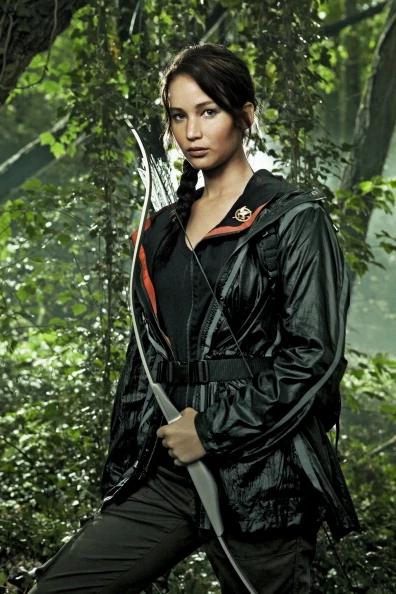
Katniss Everdeen, if you need to be told, is the protaganist of the Hunger Games books and movies. She and another character, Gale Hawthorne, are described as looking ‘Seam’ , or different than their white peers. Katniss and Gale were both played by white actors.
“I watch as Gale pulls out his knife and slices the bread. He could be my brother. Straight black hair, olive skin, we even have the same gray eyes.” Collins, Suzanne. 2014. The Hunger Games Trilogy. New York, NY: Scholastic.
Image Courtesy of Lionsgate
The Hunger Games books featuring Katniss imply some form of mixedness, while the 2012 movie…went another way.
Suzanne Collins has said she didn’t intend for characters like Katniss and Gale to be from any specific ethnic identity, but simply that in the future there had been a lot of mixing. That being said, in District 12 there were others – like Katniss’ mother, who were blonde and blue-eyed and thus not “Seam”, as the look is called.
The ‘Seam’ looking people show no evidence of having undergone ethnogenesis, but many fans have associated them with the Melungeon people of southern Appalachia – who did. (District 12 is thought to correspond to Appalachia). Melungeon is an identity I don’t understand completely – born out of mixed descent communities with heritage from Indigenous tribes, free Black persons, and white settlers. Its ethnogenesis was interrupted and hampered by chattel slavery and later Jim Crow laws. Collins may not have intended the Melungeon reference, but I take it as evidence that mixed people are hungry to see themselves on the page and on the screen.
Interestingly Melungeon – originally a slur – is thought to come from melange or mix, just as Métis comes from an ancient French word for mixture.
Louis Riel and The Métis
Real life Louis Riel and Gabriel Dumont are significant figures in the history of the Métis Nation, one of the recognized Indigenous nations in Canada. Louis Riel is a sometimes contentious figure among non-Indigenous people, as he was a leader of two resistances to Canadian colonial rule.
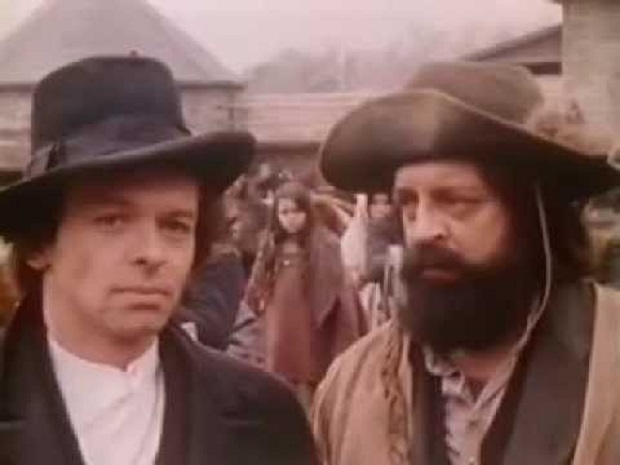
In the 1978 film Riel , 19th Century Metis leader Louis Riel is played by a French-Canadian actor, Raymond Cloutier (pictures), who is not Métis. Because Riel was also French-speaking and Catholic, he is often subsumed into a white narrative of French Catholic vs English Protestant in Canada. This in contrast to narratives in literature and among Métis that highlights his distinct Métis identity and the fact that his provisional government included English speaking Protestant Métis. I
Image courtesy of imdb.com
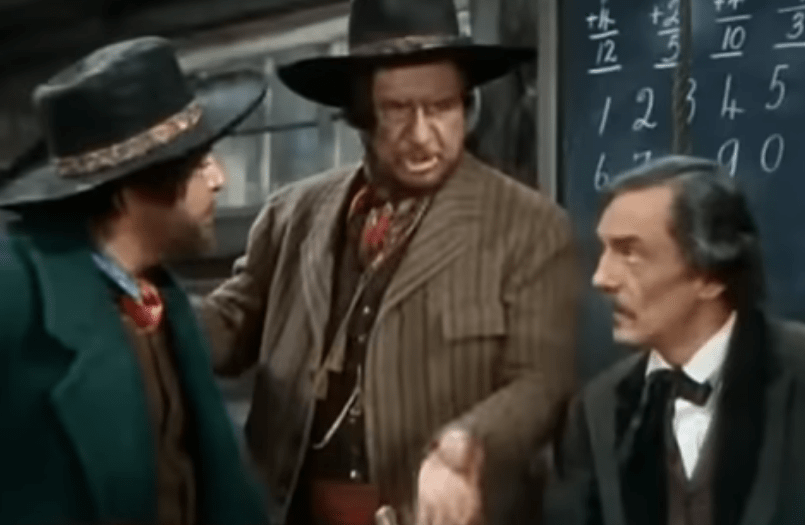
Louis Riel is also portrayed in a 1940 film, North West Mounted Police starring Gary Cooper and produced by Cecil B. DeMille. Here, Riel (played by Francis MacDonald) is a weak-willed puppet of sinister “halfbreeds.” It was not a flattering portrayal.
Image courtesy of Paramount Pictures.
Gabriel Dumont and other Métis historical persons also appear in the much more sympathetic 1998 miniseries Big Bear, made by a Métis filmmaker – although as the title suggests the main characters are Cree. Métis figures like Gabriel Dumont and Peter Erasmus and mixed (but not Métis) figures like Kitty McLean play supporting roles.

(Métis like Riel and Dumont are also featured in the graphic novel series“A Girl Named Echo” from Portage and Main Press).
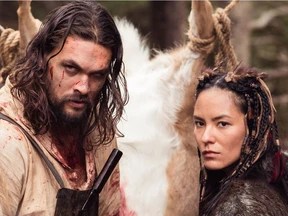
Jason Momoa’s Declan Harp and his sister Sokanan (played by Jessica Matten) in 2016’s prestige tv series Frontier might be Metis. They are more often described as “half-Cree”, I understand. But the setting is the late 18th and early 19th century, when the ethnogenesis of the Métis is just underway (and hastened by their rejection of Hudson’s Bay Company control, one of Declan’s defining traits).
Photo courtesy of the Edmonton Journal.
Both actors are mixed. Momoa has Indigenous North American ancestry as well as Polynesian, while Jessica Matten has Métis, Chinese, Cree-Saulteaux, and British descent.
Calling them half-Cree is understandable, but it can also contribute to the confusion of Métis with mixed.
Put simply all Métis are mixed, but not all mixed are Métis. Nonetheless, especially in Eastern Canada, “Métis” continues to be used (incorrectly) for any mixed person, whether they share the distinct culture and are accepted by the Métis nation or not.
“The term Métis does not encompass all individuals with mixed Aboriginal and European heritage. Instead, it refers to a distinctive people who developed their own worldview, customs, way of life, and recognizable group identity that is separate from their First Nations or European forebears.” Métis Nation British Columbia
Contrast Métis and proto-Métis with some other mixed persons in movies.
Hawk, the son of Hugh Glass in 2015’s The Revenant, is mixed, but not Métis. He doesn’t share a Métis way of life, customers, art style, or language. He isn’t in community with other Métis.
Photo © Copyright 2016 Twentieth Century Fox Film Corporation. All rights reserved.

Hawk was played by Forrest Goodluck, who is a citizen of the Three Affiliated Tribes. He is mixed in a sense himself, but a mixture of several different Indigenous nations including Navajo and Hidatsa and Tsimshian.
Elrond, Aragorn and the Half-Elves of Middle Earth
My general rule was that I was only going to look at North American native Mixedness, and not the myriad of others around the world and in fiction. But then Ralph Bakshi did this…
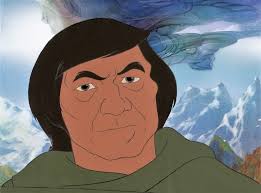

Aragorn is a Numenorean or Dunedain (who might be called Half-elf or distantly mixed) character in Tolkien’s legendarium. Tolkien made his mixed blood a highlight of the story – which wouldn’t be as remarkable save that Ralph Bakshi chose to portray him in 1978’s animated Lord of the Rings as being visually Indigenous and/or Mestizo.
This is a delightful twist on the Atlantean descent and racial essentialism that Aragorn can sometimes represent – even unintentionally.
The Dunedain and others descended from Elves who signs of ethnogenesis. They may be ‘men’ and not ‘elves’ but they have their own customs, way of life, and art. And they are considered quite different from other types of men.
The character Elrond is more distinctly Half-elf (in Elvish Peredhel) than Aragorn, but is rarely portrayed as anything but white. Nonetheless, his depiction in the 1977 animated film The Hobbit shows him as bearded.
He is considered both an Elf and an Elf-friend.
This film is directed by Arthur Rankin and Jules Bass.
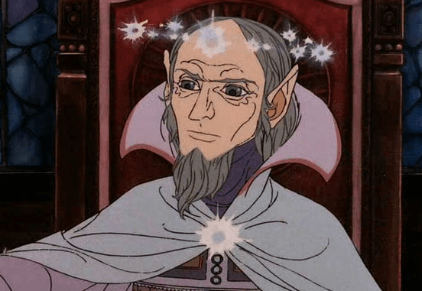
Beards are also a distinction given to mixedbloods, especially Métis, in portrayals to contrast them with their less hirsute Indigenous forebears and relations. The same is true of Half-elves and their smooth-chinned elvish ancestors. Elrond and the half-elves are an intriguing metaphor for mixedness, because in Tolkien’s world it ennobles them and also gives them a freedom to choose either mortal or elf lives – but still making them distinct. It’s a very positive view of Mixedness, although calling it Ethnogenesis might be a stretch. Nonetheless, in The Hobbit Elrond is not explicitly an elf.
“The master of the house was an elf-friend…In those days of our tale there were still some people who had both elves and heroes of the North for ancestors, and Elrond the master of the house was their chief.” J.R.R. Tolkien’s The Hobbit, Chapter 3.
One of the other reasons I like including Elrond here is that he is not the product of an Elf and a mortal human. He is a descendant of lines of half-elves, as are his children. One of the frequent questions Métis people get is about their parentage or the percentage of their blood quantum. A friend of mind told me when asked what percentage he is, he often replies “100% Métis”. This reminds me of an Elrond meme:

The spectrum of ethnogenesis is complex. The Metis fought two wars of resistance against Canada, battled the Sioux and the Hudson’s Bay Company, had their own flag and their own language. Other mixed groups who began thinking of themselves as separate might not have such a clear and distinct history to build on, and they also faced policies designed to sublimate their identities.
“Across the Americas, two very different nation-building discourses have shaped Native-white intermarriage – the strongly white supremacist abhorrence of miscegenation common to settler societies with a large white population, such as Canada and the United States, and the practice of mesizaje promoted within those Latin American countries with only a small white settler population. In western Canada a counterdiscourse rupturing concepts of miscegenation, that of métissage, also arose during a specific set of social relations in the mid-nineteenth century. These nation-building discourses have been crucial in teaching large numbers of the detribalized and mixed-blood children and grandchildren of Indigenous people to see themselves primarily as citizens of the settler states, for whom any real Indigenous identity is permanently lost.” Lawrence (2004) Pg 9.
Ethnogenesis – the creation of a new and distinct people is not generally well understood and this makes it hard to include in media if it itself is not the story you want to tell. Other examples of ethnogenesis across the world (Cape Coloured in South Africa, Eurasian and Peranakhan in Singapore, Burgers in Sri Lanka) are also not often featured in media.
I’ll give the last word in this chapter to Louis Owens, an author from the United States who identified distinctly as a mixedblood person – neither white nor First Nations. His book inspired this blog.
“I conceive of myself today not as an “Indian,” but as a mixedblood, a person of complex roots and histories. Along with my parents and grandparents, brothers and sisters, I am the product of liminal space, the result of union between desperate individuals on the edges of dispossessed cultures and the marginalized spawn of invaders.” – Owens, Louis, Mixedblood Messages: Literature, Film, Family, Place. University of Oklahoma Press, 1998.
Do you have another good example of ethnogenesis (or not) in movies, film, or comic-books? Tell me about it in the comments!
MixedMedia is a blog series Tom is writing based on explorations of his identity as a Métis person, a mixed person, and an avid consumer of pop culture.
Sources
Donahue, James J. Indigenous Comics and Graphic Novels. University Press of Mississipi, 2024.
Eugene Walz, Diane Payment & Emma Laroque. “Review: Three Views of Riel” Manitoba History, No 1, 1981.
Francis, Daniel. The Imaginary Indian. The Image of the Indian in Canadian Culture. Vancouver : Arsenal Pulp Press, 1992.L
Lawrence, Bonita. “Real” Indians and Others: Mixed-Blood Urban Native Peoples and Indigenous Nationhood. Vancouver: UBC Press, 2004.
Owens, Louis. Mixedblood Messages: Literature, Film, Family, Place. University of Oklahoma Press, 1998.
Princess Weekes “Tall, Dark, and Racially Ambiguous” august 29, 2024.
MixedMedia Chapters

 North Wind Heritage Consulting
7 thoughts on “MixedMedia Pt 1: Ethnogenesis or Not”