
Postcards from a Métis Trooper in the First World War
In 2024, my father shared with me some postcards he had kept. They were passed down by his great-grandmother, Eliza Scheer (nee Desmarais) a Métis midwife who ran a boarding house in Fort MacLeod in the early decades of the 20th century. Most were from her son George, who enlisted for the First World War.

(Courtesy of Fort Macleod Archives, FMP.80.3.3)
!["Group at Pincher Creek, Alberta.", [ca. 1910s], (CU1104041) by Unknown. Courtesy of Glenbow Library and Archives Collection, Libraries and Cultural Resources Digital Collections, University of Calgary.](https://northwindheritageconsulting.com/wp-content/uploads/2024/05/eliza-cropped-ca-1910s.png?w=274)
Now that they have come to me, I want to share them so that these words and pictures can connect family and friends across time as well as distance.
The Final Two Years
The 1914 enlistees like George had been in the war for three years, and were finally due for a break. A furlough home was a brief respite before returning for the last 100 days.
I have only one postcard from this final period and it says little. But with his military records and accounts from my grandfather, as well as the general experiences of the war’s end, we can still sketch out the last few years of George’s war.
Postcards from George
One last postcard before a visit home.
To Eliza, May/April, 1917

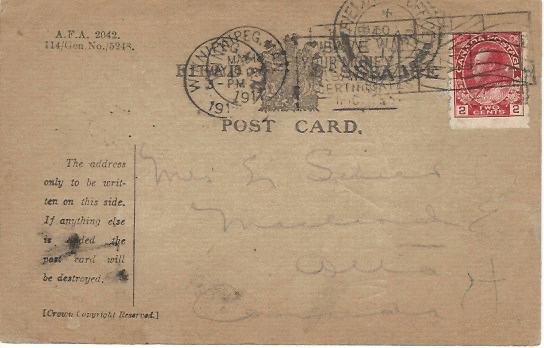
I am (quite well). I have received your letter dated (March). Letter follows at first opportunity. I have received no letter from you (lately). George. Dated April 26.
Mrs E Scheer. Macleod, Alta, Canada
This was a standard postcard that soldiers were permitted to send. It had no revealing information that could tip off spies as to troop movements or details of losses (Nor provide descendants of any stories or details, alas.)
George’s niece – my great-aunt Rita – evidently found this postcard at one point as a child and decided to write her name all over it!
The Rest of George’s War
George Scheer’s final few years includes demotions, hospital stays, and a furlough back to Canada. Fighting in the last hundred days of the war was fierce, but details are scarce.
Shortly after sending the Service Postcard, George was hospitalised for “Disorder of Dentition”, a diagnosis that could refer to any variety of unhealthy teeth. He wouldn’t rejoin his regiment for two months. He was in trouble again shortly thereafter for overstaying a granted leave – the same infraction that had cost him his promotion. But even just imagining the war, can you blame him?
![(Image cropped from "Interior of Great West Saddlery store, Fort Macleod, Alberta.", [ca. 1910], (CU191175) by Unknown. Courtesy of Glenbow Library and Archives Collection, Libraries and Cultural Resources Digital Collections, University of Calgary.)](https://northwindheritageconsulting.com/wp-content/uploads/2024/04/walter-mowbray-scougall-in-great-west-saddlery-ca-1910.png?w=771)
In August of 1917, George’s friend Walter Mowbray Scougall – with whom he and Joe Grier had enlisted – was killed by a German “whizz-bang shell.”
Walter Mowbray Scougall had joined up with his friends, but been made a Lieutenant while George and Joe were Privates – presumably because of previous two years service in the militia. He commanded platoons of Royal Canadians in England and France before his death.
He was not the first of George’s friends to be killed and certainly would not be the last.
Walter’s brother later opened a car dealership in Fort MacLeod during the 1920s, Scougall Motors, which still operates today.
(Image cropped from “Interior of Great West Saddlery store, Fort Macleod, Alberta.”, [ca. 1910], (CU191175) by Unknown. Courtesy of Glenbow Library and Archives Collection, Libraries and Cultural Resources Digital Collections, University of Calgary.)
By March 1918 George was granted furlough to return back to Canada, having fought for his country for four years. With American and ANZAC (Australian and New Zealander) troops arriving in great numbers, it was thought that a short trip home could be granted to troops who had been in Europe since the early days of the war. George embarked for his home country in April and presumably spent the summer with his family in Fort Macleod before returning to Europe in August.
The last few months of the war were not quiet (in fact, many of those who had been given furlough were called back quickly to deal with renewed German assaults). The Royal Canadians took part in the Battle of Cambrai with significant losses. The war was finally out of the trenches and the cavalry played a significant part. One of the final great cavalry charges involved Lord Strathcona’s Horse in the Battle of Moreuil Wood.
Of George we hear little more until the war ends and he is demobilised and returned to Canada.

In 1919, Edward, Prince of Wales (who served in the war himself, and was very popular with the troops) visited Alberta and met and reviewed the veterans in several cities and towns. George is undoubtedly among those pictured here, although we do not know which one he is.
George’s Life After the War
Many soldiers had difficulties returning to peacetime Canada. We know almost nothing about George’s personal experience, save that he drifts away and loses touch with his father, mother, and siblings.
The MacLeod Gazette records that he found employment again at a number of Southern Alberta newspapers for the early 1920s. He later worked as far away as Detroit and Chicago.
My grandfather records in his family history that George “was last heard from by the family in 1925 and it is assumed [as of c.1977] that he is now deceased.”
When history is filtered through postcards and military notations, we can never know the whole story. Bits and pieces come down to us like puzzle pieces or light refracted through stained glass. In the 1910s we see a man who loves his family and writes warmly and frequently. By the 1920s he drifts away and severs all ties.
I am nonetheless glad we get our puzzle pieces – for refractions are better than no light at all.

This is the final chapter of George’s story. But this blog will continue with more postcards and some appendices on the Desmarais/Scheer family.
Laurence Long quoted in Fort Macleod History Book Committee (Alberta). 19771990. Fort Macleod–our Colorful Past. Fort Macleod History Book Committee. Pgs 439-443.
I am indebted to the Military Museums of Calgary for their assistance with this project, especially:
- Corporal Miguel Blanco, Collections Manager / Archivist, Lord Strathcona’s Horse (Royal Canadians) Regimental Museum and Archives.
- Captain P.J.D. (Phil) Webster, CD Curator, Lord Strathcona’s Horse (Royal Canadians) Regimental Museum and Archives, The Military Museums.
Thanks also goes to The Fort Museum of the NWMP and First Nations Interpretive Centre, particularly:
- Christopher Richmond-Krahn, Collections Manager.
I am a descendant of Eliza (Desmarais) Scheer through her daughter Mary, grandson Laurence, and great-grandson Richard. I am a storyteller and amateur historian. This story is part of my online exhibition Dearest Mother: Postcards from a Métis Trooper in the First World War.
Chapter 1: Hurrying us Through
Chapter 2: In a Continual Downpour
Chapter 3: Imagine me walking about this place
Chapter 4: In strange contrast to the prairies
Chapter 5: Up hear near the firing line
Chapter 6: I have received no letter from you lately
Chapter 7: Cards from Family
Chapter 8: Cards from Friends
Appendix 1: A Royal Desmarais Lineage
Appendix 2: The Life of Eliza (Desmarais) Scheer
Appendix 3: Mrs. Scheer and the Browns
 North Wind Heritage Consulting
10 thoughts on “Dearest Mother Pt 6: I have received no letter from you lately”