

Postcards from a Métis Trooper in the First World War
In 2024, my father shared with me some postcards he had kept. They were passed down by his great-grandmother, Eliza Scheer (nee Desmarais) a Métis midwife who ran a boarding house in Fort MacLeod in the early decades of the 20th century. Most were from her son George, who enlisted for the First World War.

(Courtesy of Fort Macleod Archives, FMP.80.3.3)
!["Group at Pincher Creek, Alberta.", [ca. 1910s], (CU1104041) by Unknown. Courtesy of Glenbow Library and Archives Collection, Libraries and Cultural Resources Digital Collections, University of Calgary.](https://northwindheritageconsulting.com/wp-content/uploads/2024/05/eliza-cropped-ca-1910s.png?w=274)
(Glenbow Archives, CU1104041)
Now that they have come to me, I want to share them so that these words and pictures can connect family and friends across time as well as distance.
Back in the Saddle
The Strathcona Horse Regiment, George included, arrived in France in May of 1915 and spent the rest of the year acting as infantry. In January of 1916 they resumed their cavalry role and acted in several battles.
There are far fewer postcards at this point. George probably found fewer opportunities to write, but it’s also possible they didn’t survive.
As such, George’s war becomes less personal as I have to rely on his military records (generously provided by the Military Museums in Calgary). But some bits are revealed that he may not have shared with his mother and family at home.
Postcards from George
A few notes to home to his brother and father from the battlefields of Europe in 1915, then very little.
To Wilbert, June 22, 1915

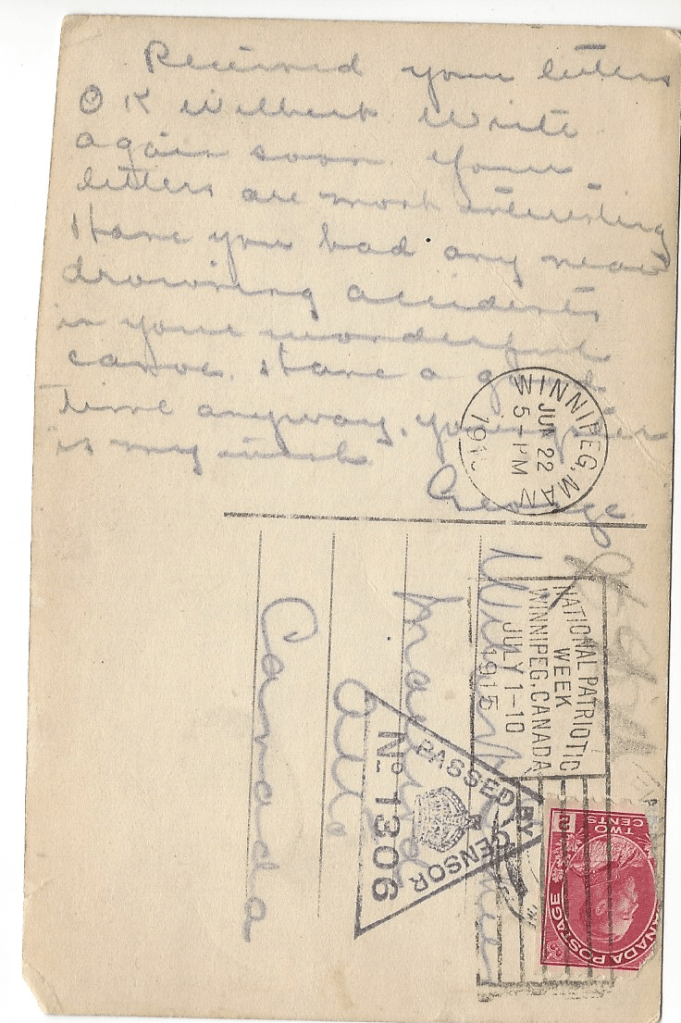
Received your letter ok. Wilbert write again soon your letters are [most?] interesting. Have you had any new drowning accidents in your wonderful canoe. Have a good time anyway. Your letter is my [wish?] George
Wilbert Scheer. Macleod, Alta, Canada.
I appreciate the good ribbing he gives his little brother about the quality of his watercraft, but it is the postcard chosen that is so meaningful. The French on the front seems to read “The Dream That Consoles” and “Little brother, often I see you in a dream driving out of my mind the gnawing doubt.”
Note that the postcards are marked as passed by the CEF’s censor.
To no one, no date. (This postcard was likely a souvenir)

The cooks of the regiment were no doubt a familiar and happy sight – although that’s not to say the grub was particularly good. In 1917, George was hospitalised for disorder of dentition (bad teeth). This needn’t sully the cooks’ reputation. They served what they had to serve, and there were a lack of good dentists at the Front – let alone good hygiene.
Too much sugar, not enough brushing, and hard military ration biscuits didn’t make for a good mix. Add unsanitary conditions and heavy smoking, and “Trench Mouth” became a danger as well, a surfeit of mouth bacteria that caused swollen and bleeding gums and a great deal of pain.
To Michael, June, 1915
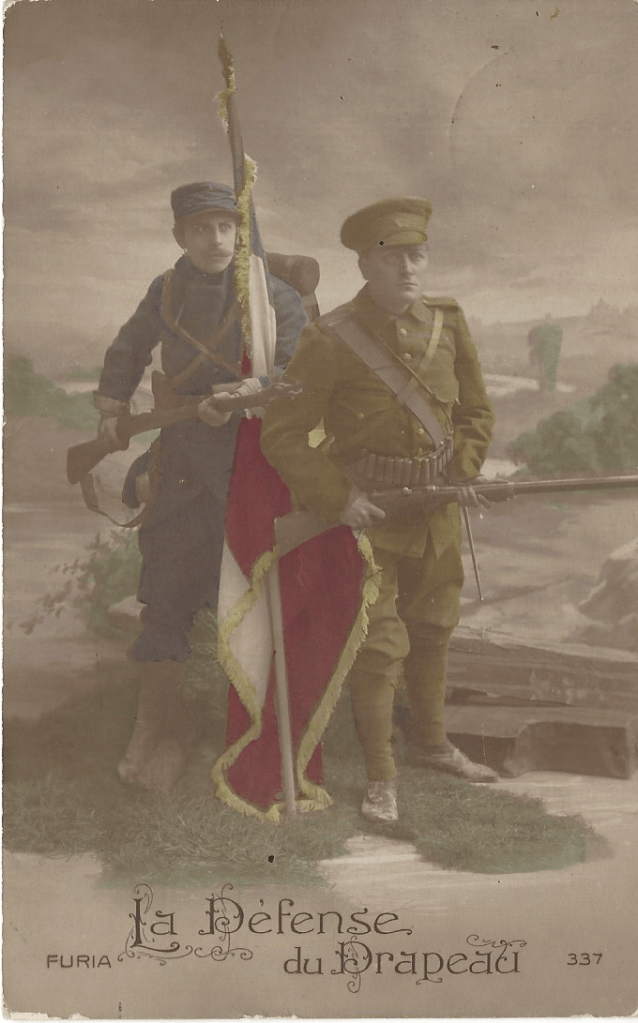
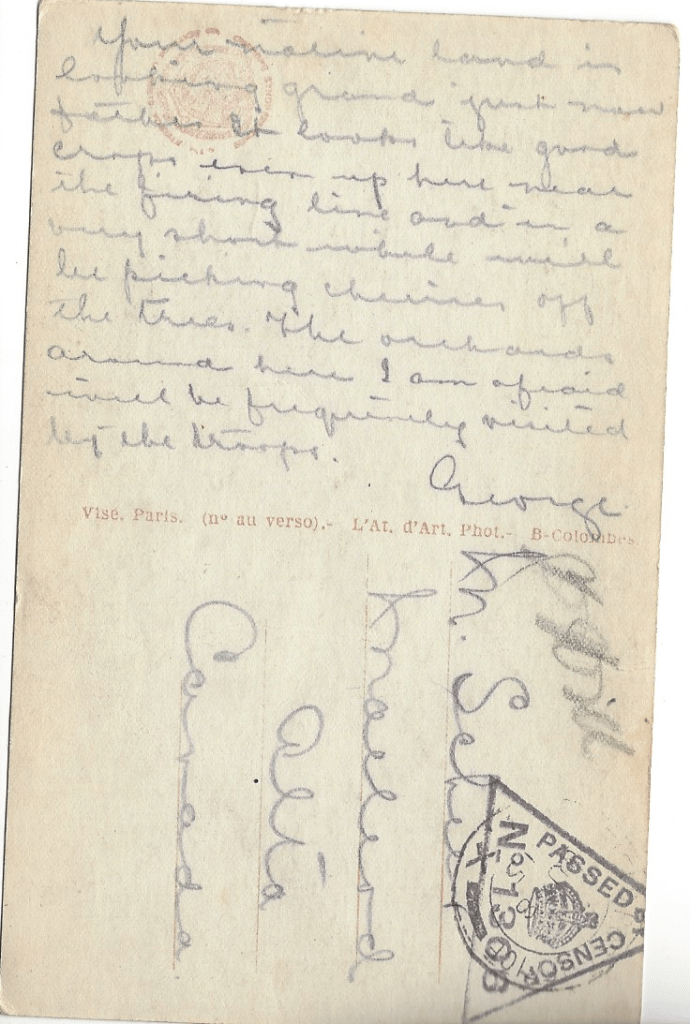
Your native land is looking grand just now father. It looks like good crops even up here near the firing line and in a very short while we will be picking cherries off the trees. The orchards around here I am afraid will be frequently visited by the troops. George.
M. Scheer. Macleod, Alta, Canada.
Michael Scheer, you’ll recall, was born in Strasbourg and a patriotic Frenchman. Alsace and the area around Strasbourg are well known as wine-growing regions, and still much visited today for their vineyards and orchards.
The French text on the postcard translates as “The Defense of the Flag” and features British/Commonwealth and French soldiers. Alsace-Lorraine was contested back and forth in the 20th and 19th century wars between France and Germany. This may be why it is now also the headquarters of the European Parliament.


No further cards come to us from 1915 or ’16. At home during this time, George’s eldest brother Arthur attempted to sign up for the war at Lethbridge. My grandfather Laurence Long doesn’t mention it in his family history, so Arthur, at 37, may not have been accepted. Pressure at home for more men to sign up was building as the war continued on and casualties mounted.
George was promoted to Lance Corporal in October of 1915, although he was soon demoted back to Private for excessive instances of overstaying his leave. He was hospitalised in 1916 for Scabies, an awful infection by a type of mite. This is usually spread by close living quarters – so it could have been a trench/camp infection or it could be that George contracted it from a prostitute on one of his leaves – not unheard of. It might also be spread by horses to their riders. The infection and that period’s treatment are shiver-inducing to read about.
In early 1917 Lord Strathcona’s Horse (Royal Canadians) took part in the defence of the Somme front. One of the unit’s Lieutenants, Frederick Harvey (another Southern Alberta boy), was awarded the Victoria Cross for rushing and capturing a German machine gun nest in this action.
With the United States entering the war in April of 1917, as well as reinforcements from Australia and New Zealand, it looked as if the early enlistees like George would have a chance for a break after three long years.

Laurence Long quoted in Fort Macleod History Book Committee (Alberta). 19771990. Fort Macleod–our Colorful Past. Fort Macleod History Book Committee. Pgs 439-443.
I am indebted to the Military Museums of Calgary for their assistance with this project, especially:
- Corporal Miguel Blanco, Collections Manager / Archivist, Lord Strathcona’s Horse (Royal Canadians) Regimental Museum and Archives
- Captain P.J.D. (Phil) Webster, CD Curator, Lord Strathcona’s Horse (Royal Canadians) Regimental Museum and Archives, The Military Museums
I am a descendant of Eliza (Desmarais) Scheer through her daughter Mary, grandson Laurence, and great-grandson Richard. I am a storyteller and amateur historian. This story is part of my online exhibition Dearest Mother: Postcards from a Métis Trooper in the First World War.
Chapter 1: Hurrying us Through
Chapter 2: In a Continual Downpour
Chapter 3: Imagine me walking about this place
Chapter 4: In strange contrast to the prairies
Chapter 5: Up hear near the firing line
Chapter 6: I have received no letter from you lately
Chapter 7: Cards from Family
Chapter 8: Cards from Friends
Appendix 1: A Royal Desmarais Lineage
Appendix 2: The Life of Eliza (Desmarais) Scheer
Appendix 3: Mrs. Scheer and the Browns
 North Wind Heritage Consulting
10 thoughts on “Dearest Mother Pt 5: Up Hear Near the Firing Line”