

Postcards from a Métis Trooper in the First World War
In 2024, my father shared with me some postcards he had kept. They were passed down by his great-grandmother, Eliza Scheer (nee Desmarais) a Métis midwife who ran a boarding house in Fort MacLeod in the early decades of the 20th century. Most were from her son George, who enlisted for the First World War.

(Courtesy of Fort Macleod Archives, FMP.80.3.3)
!["Group at Pincher Creek, Alberta.", [ca. 1910s], (CU1104041) by Unknown. Courtesy of Glenbow Library and Archives Collection, Libraries and Cultural Resources Digital Collections, University of Calgary.](https://northwindheritageconsulting.com/wp-content/uploads/2024/05/eliza-cropped-ca-1910s.png?w=274)
(Glenbow Archives, CU1104041)
Now that they have come to me, I want to share them so that these words and pictures can connect family and friends across time as well as distance.
Closer to France, Farther from Home
In early 1915, George is moved as his regiment becomes part of the Canadian Calvary Brigade. But France still seems far off.
A history of the Canadian Expeditionary Force (all the soldiers sent by Canada to the war), notes that February 1915 saw the formation of the Canadian Cavalry Brigade “from the Royal Canadian Horse Artillery, the Royal Canadian Dragoons, Lord Strathcona’s Horse, and the 2nd King Edward’s Horse…the cavalry Brigade concentrated near Uckfield, Sussex, under a British officer, Colonel J.E.B. Seely…” (Nicholson, 2015)
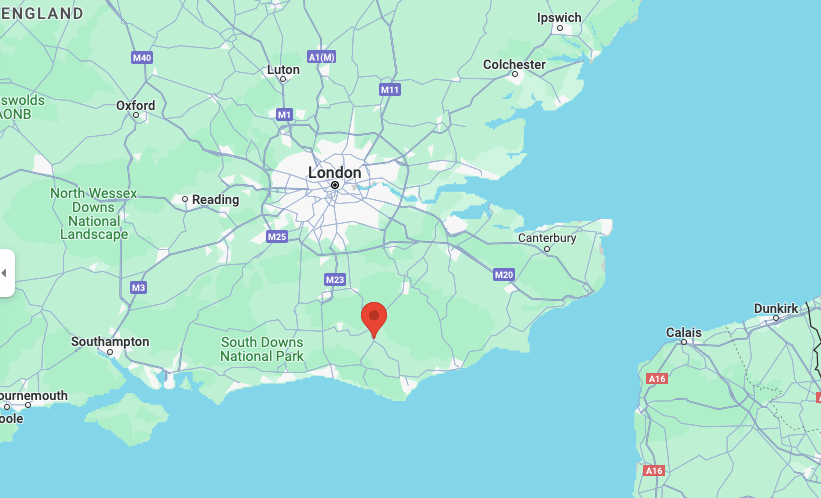
Thus in this collection of March postcards, we find George Scheer and his fellow troopers moved from Pewsey to Uckfield, south of London. It has been seven months since he left MacLeod for the war and he has still not made it to France (although now he is a little closer).
Some homesickness is hinted at in his constant comparisons of Sussex to southern Alberta.
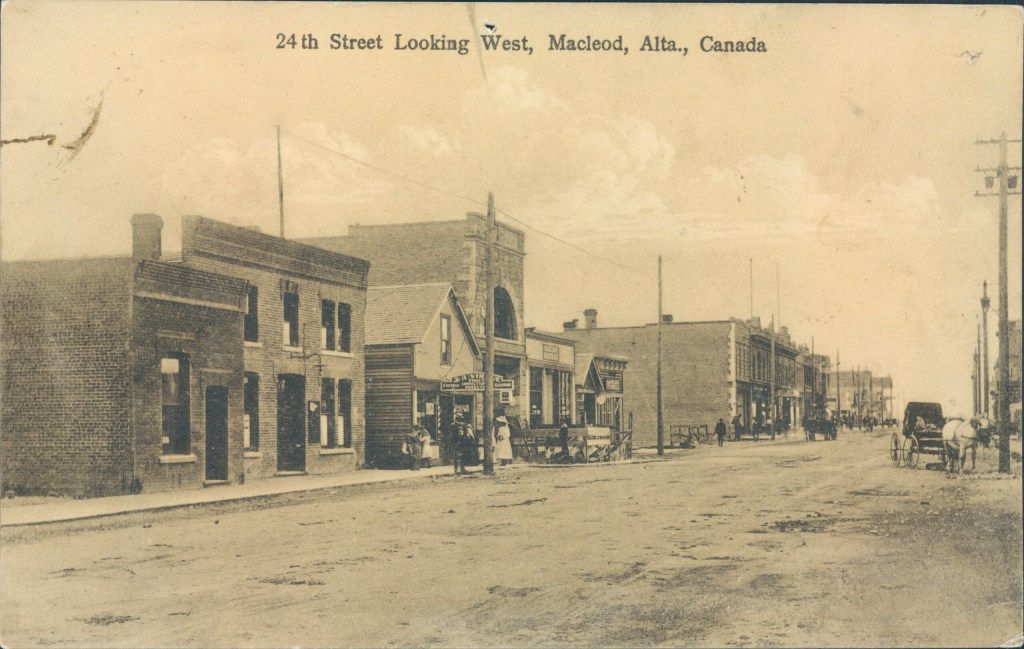
Postcards from George
To Eliza, March 24, 1915
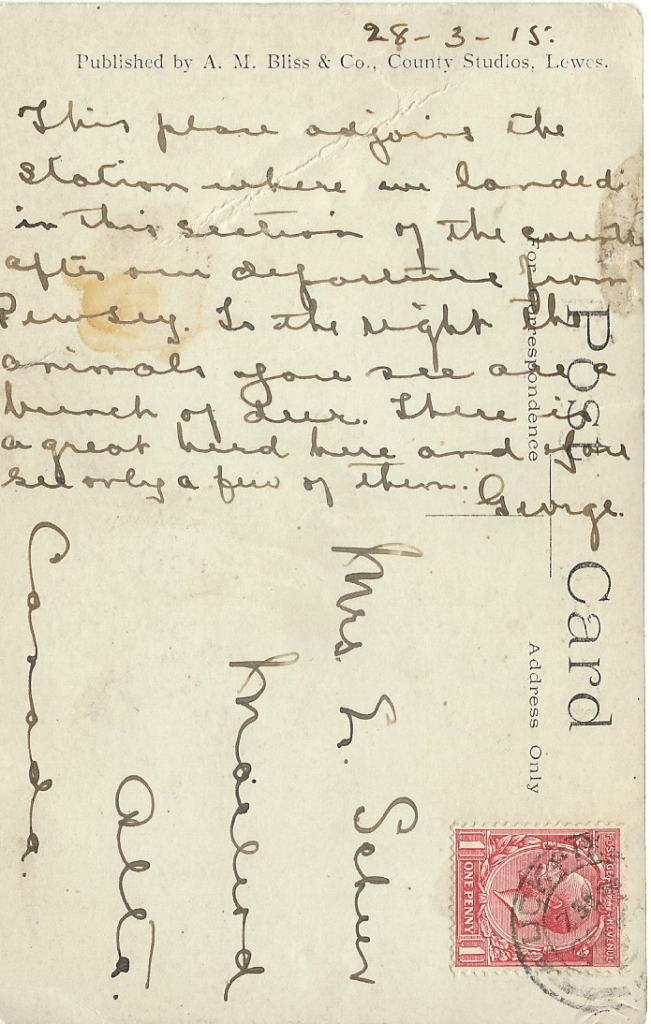
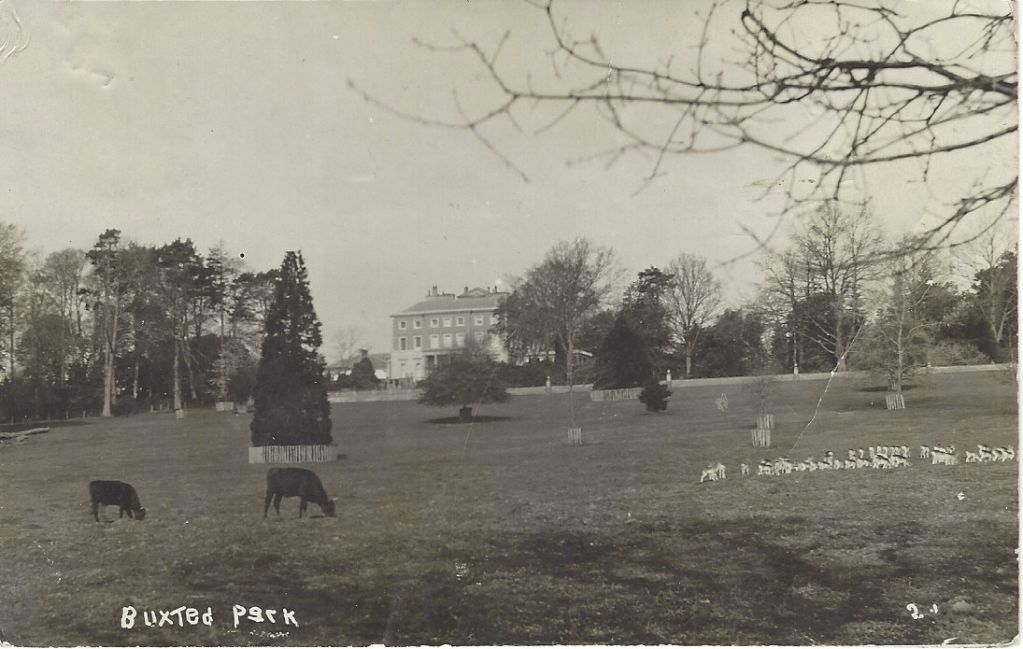
This place adjoins the station where we landed in this section of the country after our departure from Pewsey. To the right the animals you see are a bunch of deer. There is a great herd here and you see only a few of them. George.
Mrs. E. Scheer. McLeod, Alta, Canada.
Maresfield Park, their new home, was once a deer hunting preserve of the British monarch. Somehow when I read this I hear a few strains from “Home on the Range”.
To Eliza, March 24, 1915
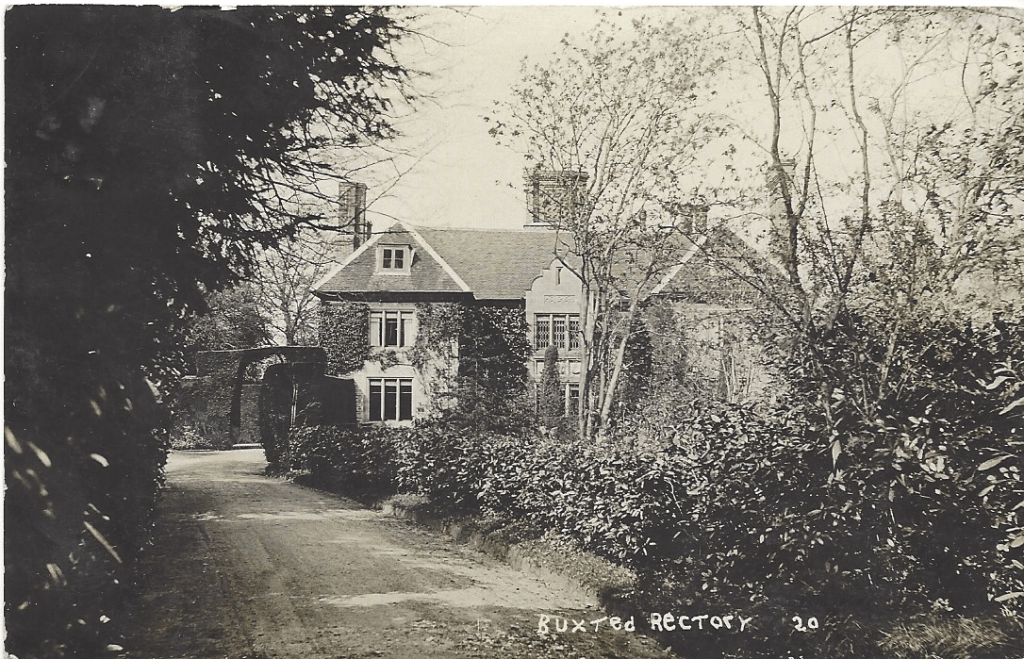
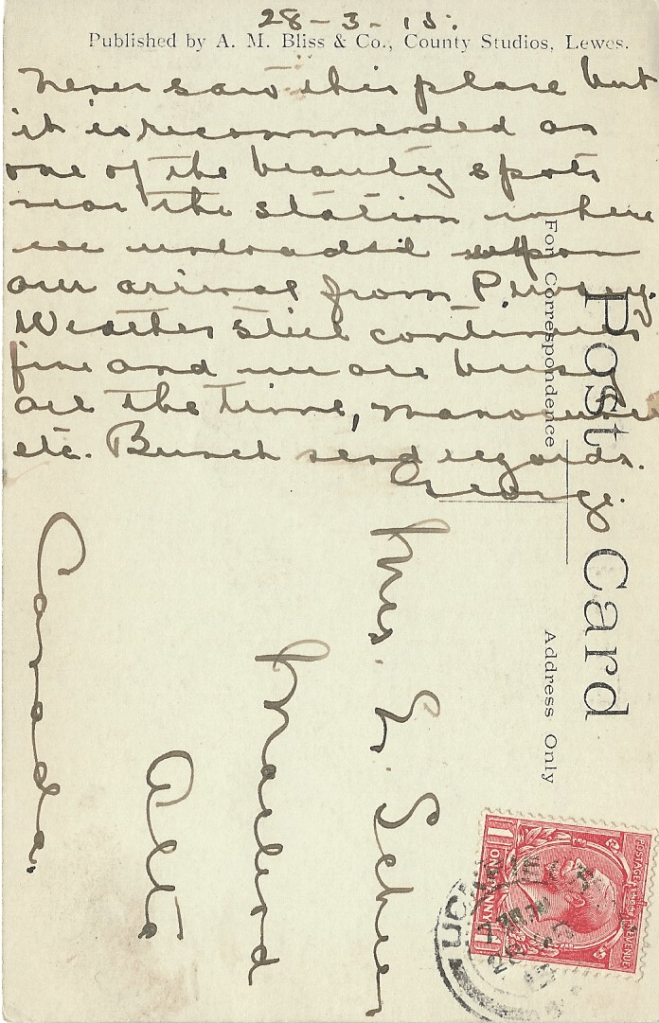
Never saw this place but it is recommended as one of the beauty spots near the station where we unloaded upon our arrival from Pewsey. Weather still continuing fine and we are busy all the time, maneouvres, Etc. Bunch send regards. George.
Mrs. E. Scheer. McLeod, Alta, Canada.
Buxted Rectory still stands in Sussex
To Eliza, March 24 1915
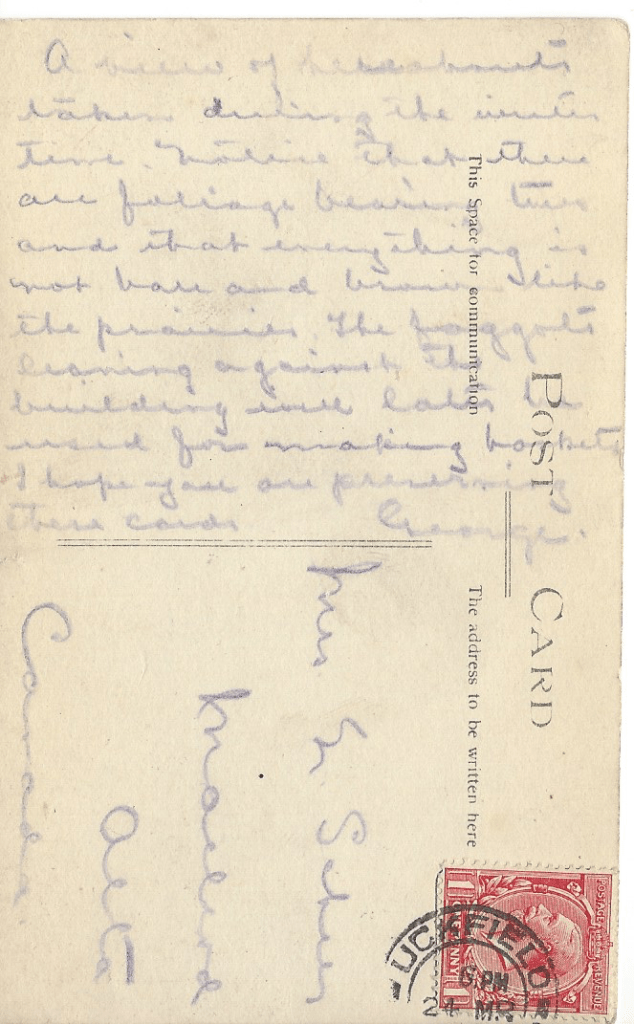
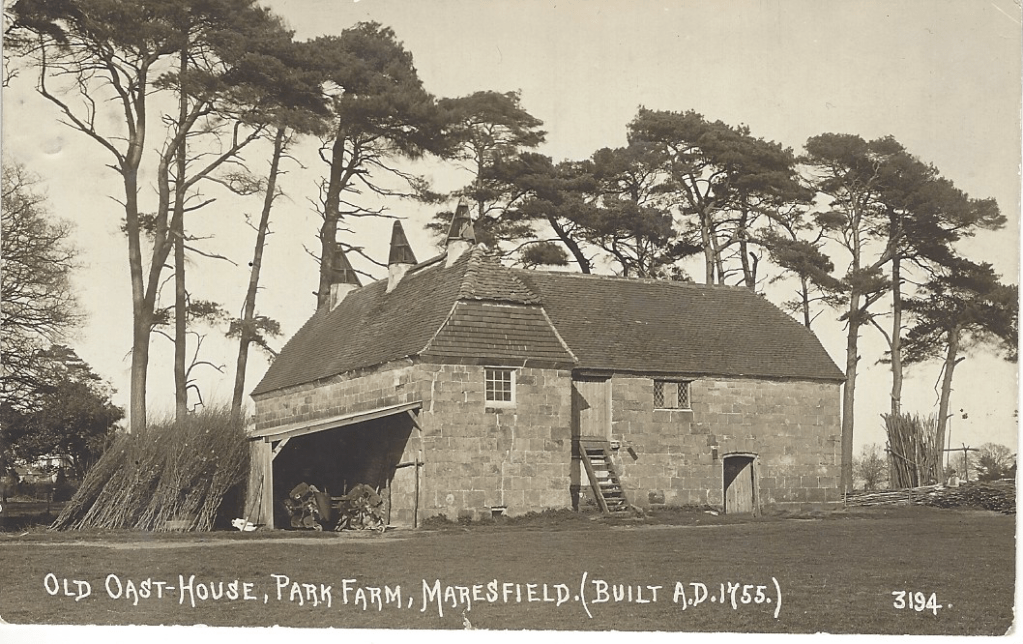
View of [xxxlands?] taken during the winter time. Notice that there are foliage bearing trees and that everything is not bare and brown like the prairies. The faggots leaning against the building will later be used for making baskets. I hope you are preserving these cards. George.
Mrs. E. Scheer. McLeod, Alta, Canada.
She was, in fact, keeping the cards!
An oast-house is a kiln for drying hops, to be used in the brewing business. It is a touch curious that George doesn’t mention this to his mother. Did she disapprove of beer? Or did he just assume she would know that? Hop-growing was a large industry in Sussex, where Uckfield was situated.
Obviously at the time bundles of sticks were referred to in a manner we would not today.
To Eliza, March 24, 1915
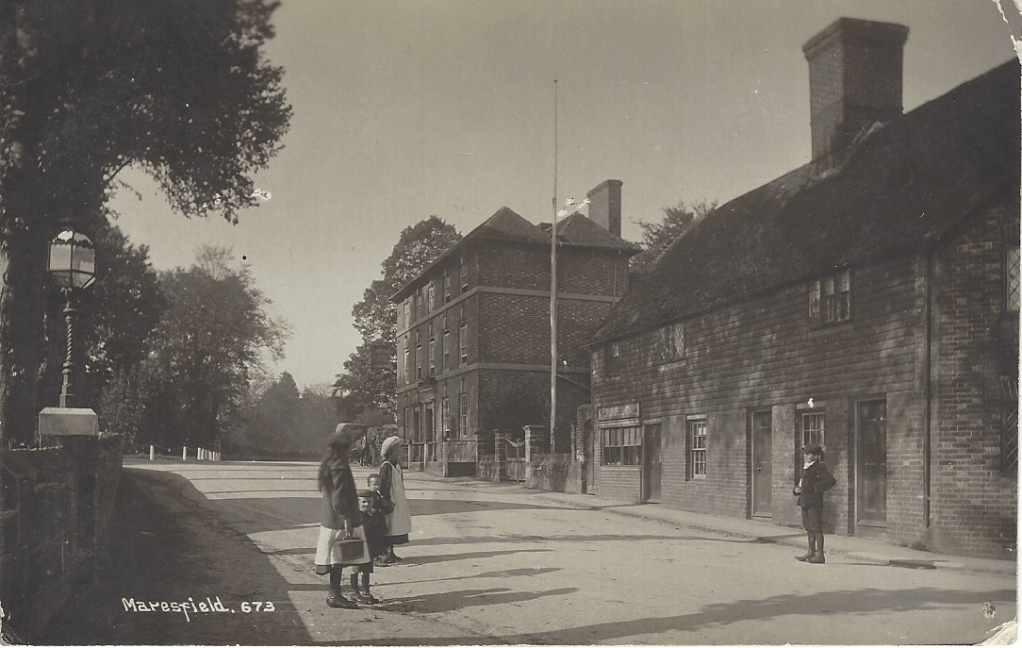

This is the Main St view of a village adjoining our camp. It looks rather pretty during summer [does it not?] Although all the trees are not yet in leaf still they are coming [around?] and in a few weeks they [will?] resemble the pc. George.
Mrs E Scheer. Macleod, Alta, Canada.
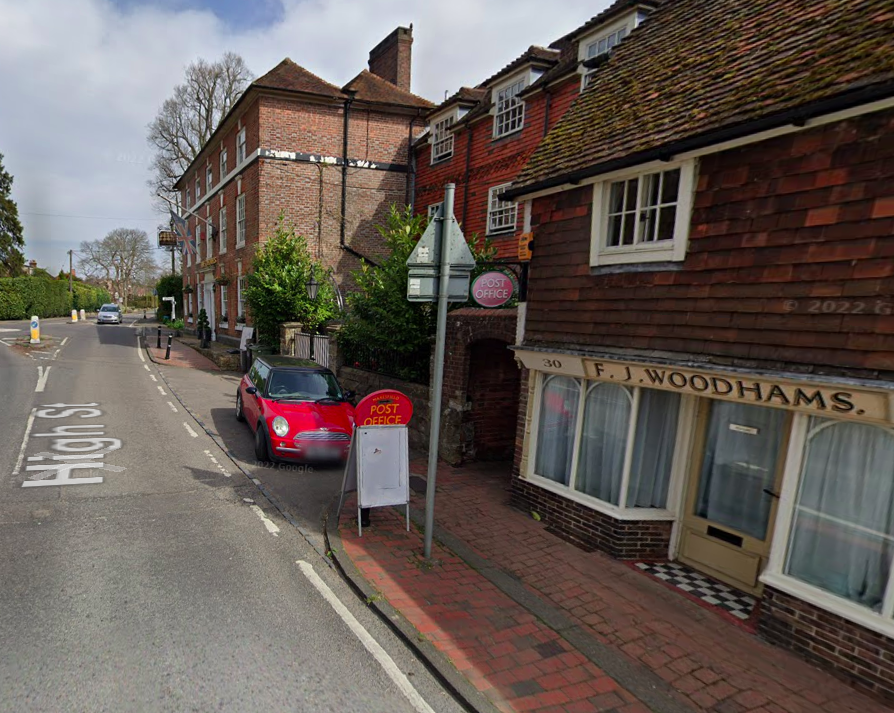
Main Street in Maresfield hasn’t changed that much in a century!

To Eliza, March 24, 1915
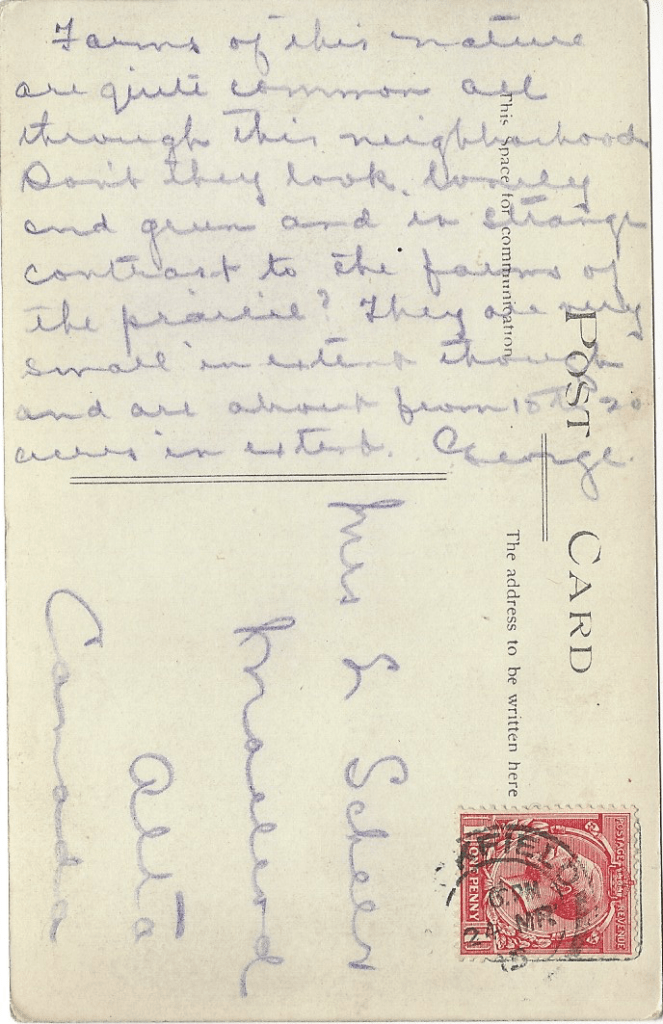
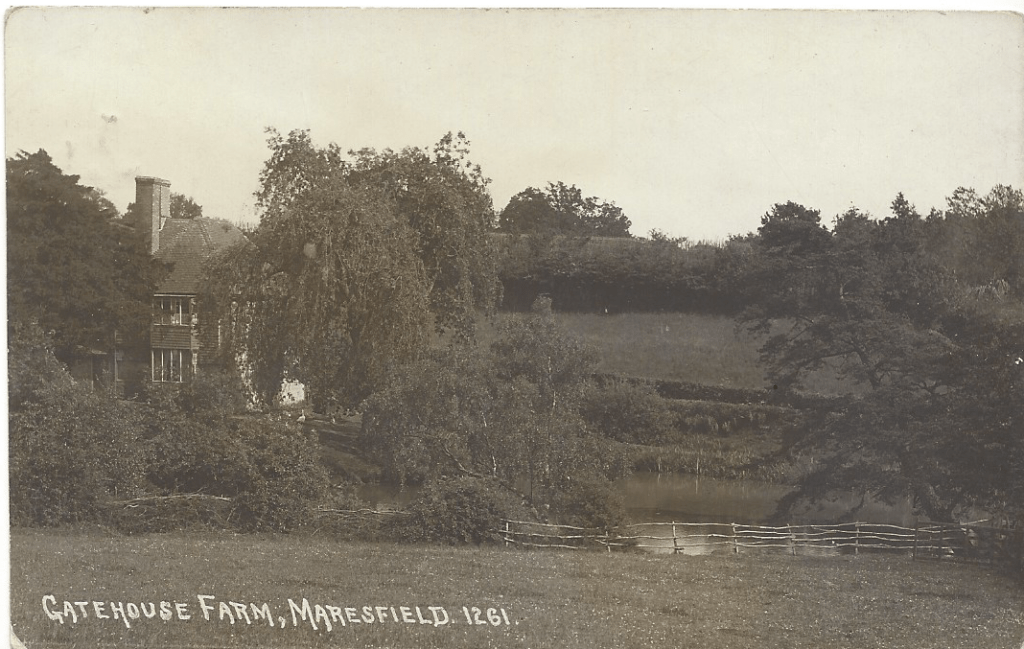
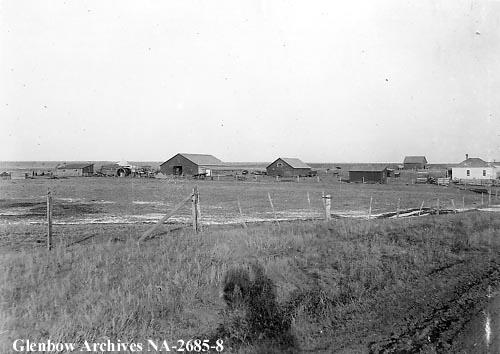
Farms of this nature are quite common all through this neighbourhood. Don’t they look lovely and green and in strange contrast to the farms of the prairie? They are very small in extent though and are about from 15 to 20 Acres in extent. George.
Mrs. E Scheer. Macleod, Alta, Canada
Early farms in Western Canada, by contrast, were most often 160 or 320 acres (or more).
To Eliza, March 24, 1915
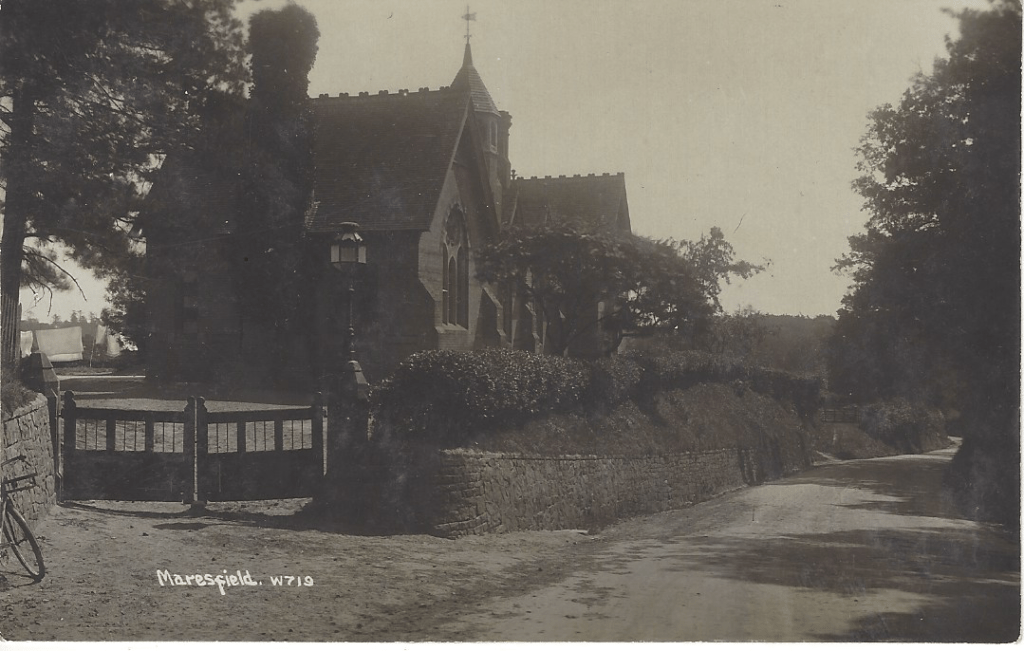
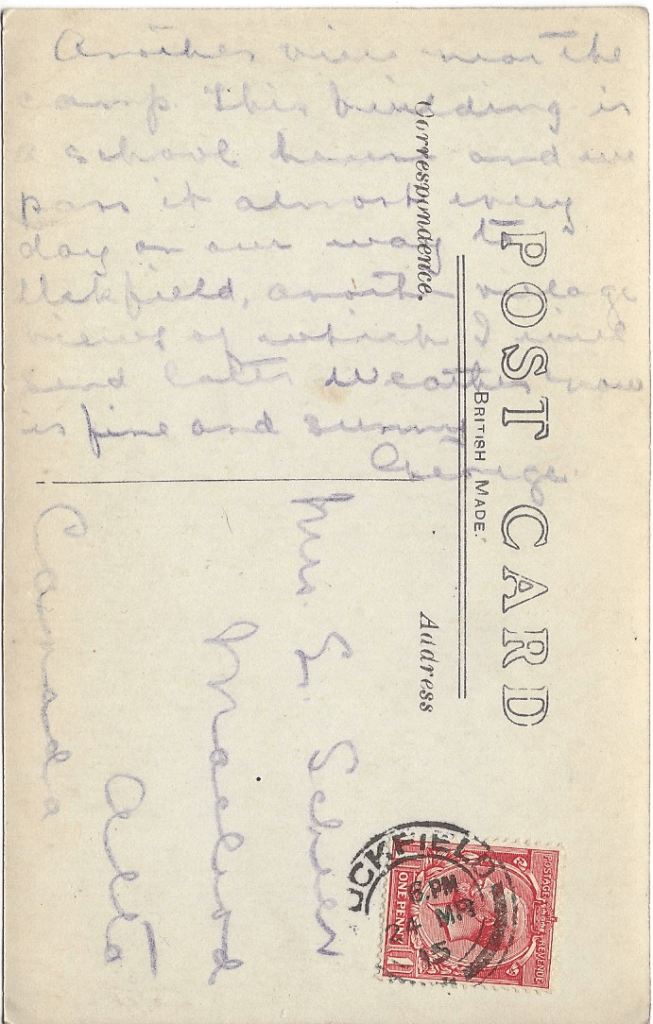
Another view near the camp. This building is a school house and we pass it almost every day on our way to Uckfield, Another village view of which I will send later. Weather now is fine and summery. George.
Mrs. E. Scheer, Mcleod, Alta, Canada
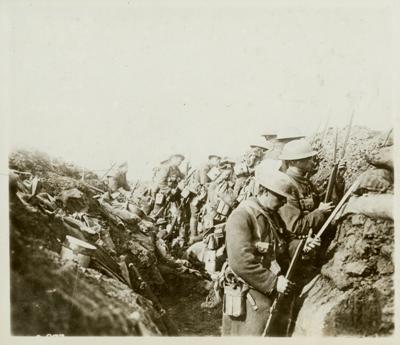
With the cold English winter now finally behind them, George and the Royal Canadians shipped out for France in May of 1915. It was not to be a mounted detail, however. Tremendous losses to the first Canadian contingent were a harbinger of the gruesome toll of the war. Most of the Canadian Cavalry Brigade left for France to serve as infantry for the rest of the year. The life of a printer in Fort Macleod must have seemed quite distant.
Laurence Long quoted in Fort Macleod History Book Committee (Alberta). 19771990. Fort Macleod–our Colorful Past. Fort Macleod History Book Committee. Pgs 439-443.
Nicholson, G.W.L. Canadian Expeditionary Force, 1914-1919: Official History of the Canadian Army in the First World War. McGill-Queen’s University Press, 2015. http://www.jstor.org/stable/j.ctt18kr4hw.
I am a descendant of Eliza (Desmarais) Scheer through her daughter Mary, grandson Laurence, and great-grandson Richard. I am a storyteller and amateur historian. This story is part of my online exhibition Dearest Mother: Postcards from a Métis Trooper in the First World War.
Chapter 1: Hurrying us Through
Chapter 2: In a Continual Downpour
Chapter 3: Imagine me walking about this place
Chapter 4: In strange contrast to the prairies
Chapter 5: Up hear near the firing line
Chapter 6: I have received no letter from you lately
Chapter 7: Cards from Family
Chapter 8: Cards from Friends
Appendix 1: A Royal Desmarais Lineage
Appendix 2: The Life of Eliza (Desmarais) Scheer
Appendix 3: Mrs. Scheer and the Browns
 North Wind Heritage Consulting
10 thoughts on “Dearest Mother Pt 4: …In Strange Contrast to the Farms of the Prairie”