

Postcards from a Métis Trooper in the First World War
In 2024, my father shared with me some postcards he had kept. They were passed down by his great-grandmother, Eliza Scheer (nee Desmarais) a Métis midwife who ran a boarding house in Fort MacLeod in the early decades of the 20th century. Most were from her son George, who enlisted for the First World War.

(Courtesy of Fort Macleod Archives, FMP.80.3.3)
!["Group at Pincher Creek, Alberta.", [ca. 1910s], (CU1104041) by Unknown. Courtesy of Glenbow Library and Archives Collection, Libraries and Cultural Resources Digital Collections, University of Calgary.](https://northwindheritageconsulting.com/wp-content/uploads/2024/05/eliza-cropped-ca-1910s.png?w=274)
(Glenbow Archives, CU1104041)
Now that they have come to me, I want to share them so that these words and pictures can connect family and friends across time as well as distance.
How ya gonna keep ’em down on the farm?
A trip to London gives George a taste of big city living.
In January of 1915, having been in the country for two rainy months, George and his friends were given leave and spent some time in the City of London. It is hard to imagine the shock of a small-town Métis printer being among the bustle of the “Big Smoke” but the first fifteen seconds or so of this video might give some idea of the crowds and streetscapes of London in that year.
Postcards from George
George and his friends visit London, try to stave off boredom in Pewsey.
To Eliza, Jan 23, 1915
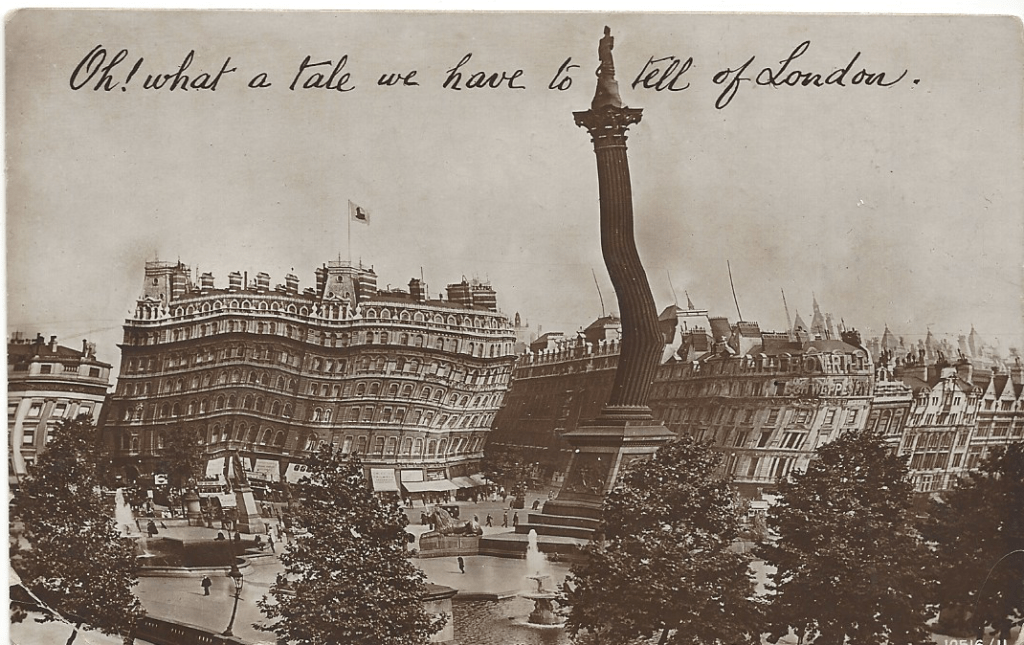
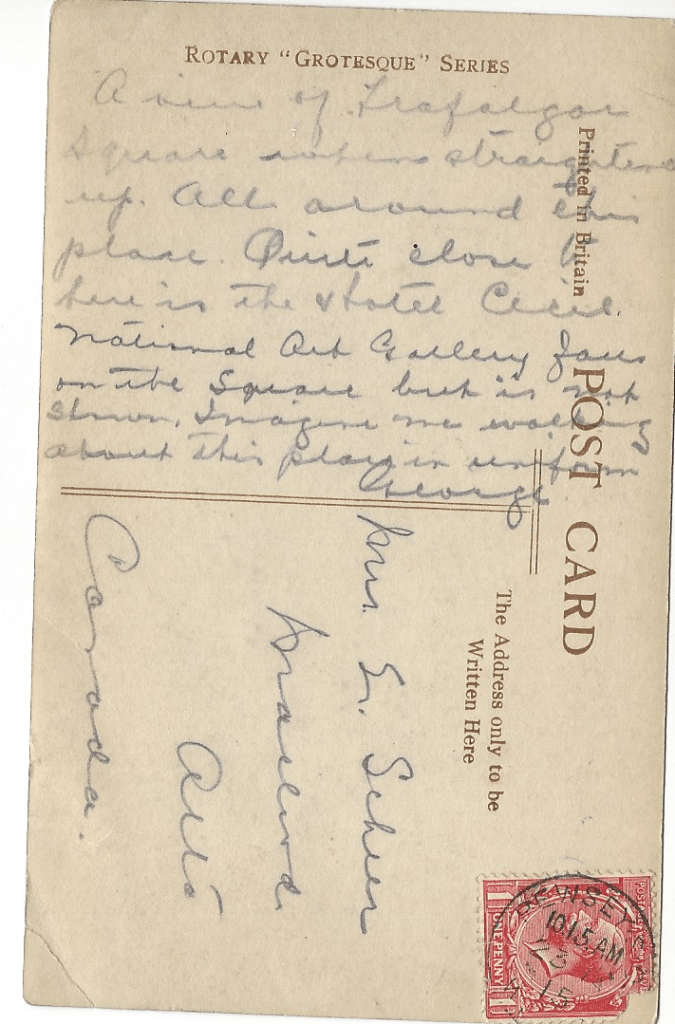
A view of Trafalgar Square when straightened up. All around this place. Quite close here is the Hotel Cecil. National Art Gallery [falls?] on the square but is not shown. Imagine me walking about this place in uniform. George.
Mrs. E Scheer. Macleod, Alta, Canada.

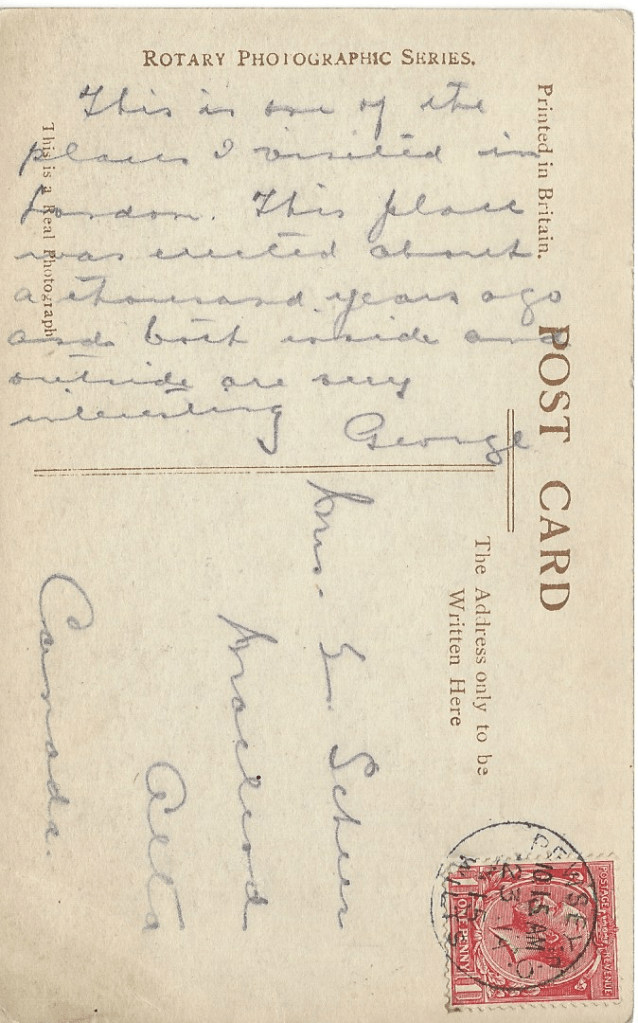
This is one of the places I visited in London. This place was erected about a thousand years ago and both inside and outside are very interesting. George.
Mrs. E Scheer. Macleod, Alta, Canada.
There was a popular song during the First World War “How you gonna keep up down on the farm, after they seen Paree?” It conveyed some of the thrills had by all the country-boys from Canada (and later the U.S.) in the big cities of Europe, and some of the worry that they would not want to return to rural living.
Soon George was back in quaint little Pewsey among the Royal Canadians and other soldiers.
To Wilbert, February 13, 1915

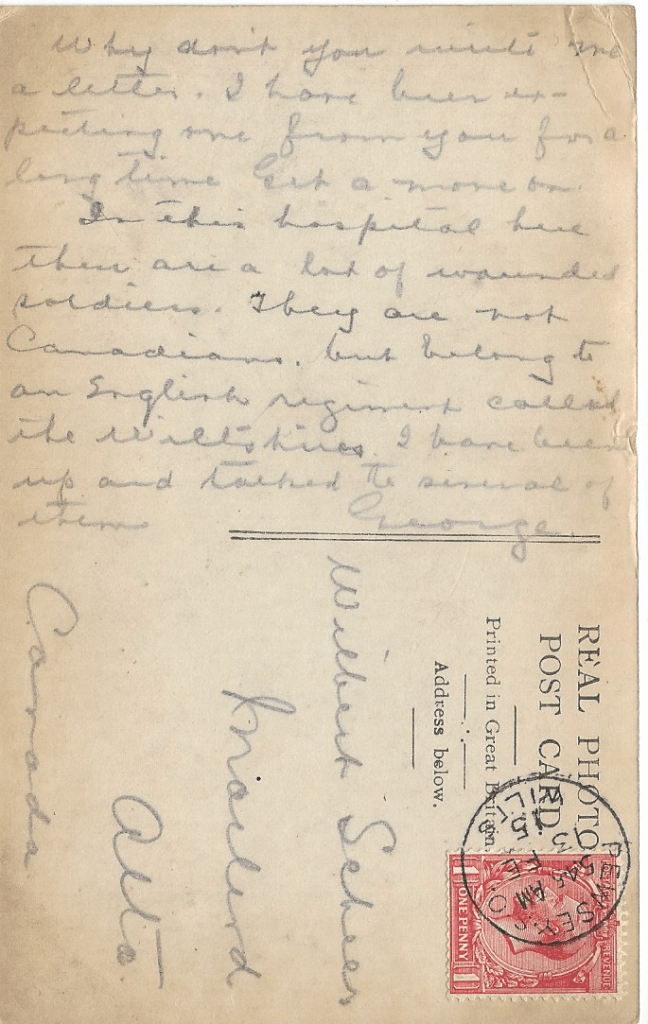
Why don’t you write me a letter. I have been expecting one from you for a long time. Get a move on. In this hospital here there are lots of wounded soldiers. They are not Canadians but belong to England regiment called the Wiltshires. I have been up and talked to several of them. George.
Wilbert Scheer. Macleod, Alta, Canada.
George had not been hospitalised, but obviously enjoyed visiting soldiers who had been to the front. Many Canadians were eager to get over to France and finish their endless drilling and marching. At the same time, meeting soldiers who had been to the trenches must have been intimidating.
George was obviously homesick as well, and having some beloved brothers myself, I can tell you that not hearing from them for a while can be quite lonesome. But my grandfather Larry described Wilbert as “well known, even as a child, for being a hustler – selling papers and doing odd jobs, always accompanied by a little black cocker spaniel called ‘Mike.'” Perhaps we can forgive the little hustler for not sitting down to write his older brother.
The Wiltshires were officially known by two names, much like George’s Regiment. The Duke of Edinburgh’s (Wiltshire Regiment) fought in France from 1914 to 1918 as well as several other theatres of the war. They won over 60 battle honours and lost over 5000 men killed. Pewsey was in the county of Wiltshire.
To Eliza, March 24, 1915


This is where we are billeted. The place along the street which I have marked with an x is where Joe Grier, myself and three others are staying. Compare this with other postcards I have sent and mark the similarity. George.
Mrs. E Scheer. Macleod, Alta, Canada.
(You can see the X on the left side of the row of buildings.)
The Strathconas were likely very happy to get out from under canvas and into a proper building. While the street has changed a little, it is likely that the building still stands. Note the similarity of the buildings on the left.


George shared the billet with Joe Grier. Like the Scheers, the Grier family was mixed – although their descent wasn’t Cree, but from the Pikani branch of the Blackfoot Confederacy. Joe and George joined up together, along with their friend William Mowbray Scougall – although the latter was made an officer and did not live with his enlisted friends.
Joe Grier’s obituary, written by his son, details how he once drove cattle up to the Yukon Goldfields and was the great-grandson of Sitting on Eagle Tail Feathers, a Chief of the Pikani at the signing of Treaty 7. George and his brothers were all riders and cowboys, just like Joe and most of the young men in Fort MacLeod. Good recruits for a mounted division.
Métis and First Nations young men signed up for the war just as fast as the descendants of Britons. A few famous Indigenous Canadians in the First World War included Alex Decoteau and Henry “Ducky” Norwest of Edmonton, and Frederick Loft and Tom Longboat of Ontario. George did not list his Métis heritage in his enlistment and the army did not ask. Better records are available regarding First Nations who enlisted, as their heritage and legal status (and often eliminating both) was of great concern to the Canadian government.
George and Joe, and thousands of their fellow countrymen, had now been across Canada and England, including London. Their eventual return from war would wreak changes across both countries, with labour struggles, a deadly influenza, and PTSD among the more severe challenges.
Laurence Long quoted in Fort Macleod History Book Committee (Alberta). 19771990. Fort Macleod–our Colorful Past. Fort Macleod History Book Committee. Pgs 439-443.
I am a descendant of Eliza (Desmarais) Scheer through her daughter Mary, grandson Laurence, and great-grandson Richard. I am a storyteller and amateur historian. This story is part of my online exhibition Dearest Mother: Postcards from a Métis Trooper in the First World War.
Chapter 1: Hurrying us Through
Chapter 2: In a Continual Downpour
Chapter 3: Imagine me walking about this place
Chapter 4: In strange contrast to the prairies
Chapter 5: Up hear near the firing line
Chapter 6: I have received no letter from you lately
Chapter 7: Cards from Family
Chapter 8: Cards from Friends
Appendix 1: A Royal Desmarais Lineage
Appendix 2: The Life of Eliza (Desmarais) Scheer
Appendix 3: Mrs. Scheer and the Browns
 North Wind Heritage Consulting
10 thoughts on “Dearest Mother Pt 3: Imagine Me Walking About This Place”