
Expo ’86 is not something in my own memory, although I was alive and only a dozen hours from Vancouver at the time. Strangely, despite often driving to visit relatives on Vancouver Island, my family didn’t go. Instead I formed connections with it through my work on Fort Edmonton park’s York Boat project (soon to come as a post), one version of which was launched there. Having since studied the Golden Hinde, I became interested in more boats from Expo ’86. Enter the Indonesian entry and its own rollicking tale.
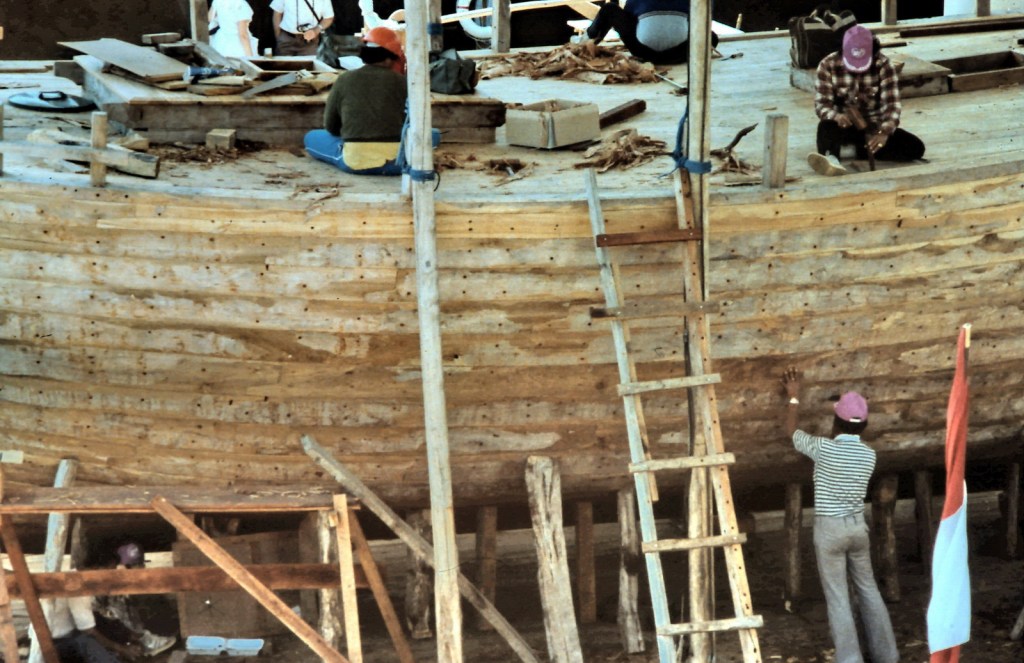
Photo Courtesy of CanadaGood Gregory. For more information (and more photos) visit http://www.Flickr.com/CanadaGood
While a multitude of boats were on display at Expo ’86, the Indonesians not only sailed one “Phinisi” to Vancouver, but actively built another one there! Many boaties recorded that this was one of their favourite parts of the boating exhibits, and I can attest from my work at FEP that seeing the process is as meaningful or more meaningful than seeing the product.
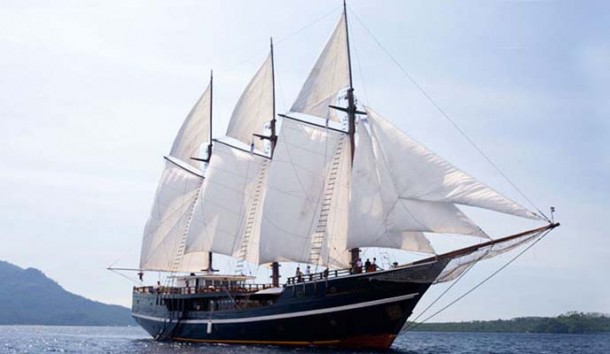
This boat has commonly been called a Pinisi (or Phinisi), but from my research that is actually a style of rigging, a “particular combination of sails and spars.” The vessels commonly rigged in this manner are the lambo and palari. It isn’t clear which of these was built at Expo ’86 and thus the subject of our tale.

(To further complicate things, the common spelling is Pinisi, but because the Indonesian pronunciation softens the “P”in a unique way, this has often been anglicised as Phinisi.)
The product in this case, was a vessel dubbed Phinisi Antar Bangsa (sometimes identified as Phinisi Ansar Bangsa).
Specifications
55ft long according to this source.
Benefits of the Build
Indonesia decided to go all out for Expo ’86. Not entirely surprisingly, this has something to do with politics. The fair “…was held during the height of Indonesian president Suharto’s “New Order” regime of integrationism, procapitalist expansion, and industrialization, which began when he took power in 1967.” (Goldman & Strachan, 2020) An impressive showing at Expo, the authors of this 2020 paper suggest, would cement Indonesia’s sovereignty and cultural vibrancy at a time when brutal authoritarian repression was going on at home.
Boatbuilding and boatcraft formed a cornerstone of Indonesia’s pavilion and presence. They sent a plethora of traditional boats from across the country. “…the Indonesian contributions to the Marine Plaza were outstanding in every respect.” (Leigh, 1987) The 130ft Phinisi Nusantra, was sailed across the Pacific to arrive at Vancouver. The 55ft Phinisi Antar Bangsa, was built at Expo in full view of the public.
Drew Clarke, who later owned Phinisi Antar Bangsa, recalled that the materials for this build, mostly teak lumber, were shipped in a container to Vancouver. That’s where the project had to pass its first Canadian hurdle. According to a website written by one of the Expo ’86 wharfingers, the pieces had been disassembled and stored in a particular way – one not appreciated by some of the Expo staff.
“During the show, a group from a remote island in Indonesia built a 55-foot traditional wood construction cargo boat (Pinisi). It had no nails, natural fibre calking and used lime for antifouling. They … shipped it in 3 containers to Vancouver. Expo management wanted to unload the containers and put the wood all in a big pile in some space they had. I had a look and told them that if they did that they would have some pretty mad boatbuilders and would likely not have a finished boat by the end of the fair. The multitude of bits and pieces were not touched.” (Expo86.ca)
The materials’ organisation thus preserved, the build thereafter took place over the course of Expo ’86, recalled as a thrill by attendees.

The build used all wood, with teak as the hull and ironwood for the keel and the trenails. Bark from palm trees were driven in as caulking. A commenter on a flickr photo relate that the trenails (tree nails, or wooden pegs) were driven in with accompanying drumming.
The launch was scheduled for July, after which the rigging would be added so that the boat was complete in time for Indonesia’s national day in August, according to an interview found here (along with footage of the builders caulking the boat).

Life After Launch
After the build, the story gets even more interesting!

The aftermath of Expo ’86 has affected countless people and places, and this boat was no different. It seems as if there wasn’t a clear plan with what to do with Phinisi Antar Bangsa after the fair, and according to its later owner Drew Clarke, it was donated to the Vancouver Maritime Museum. “…an unwanted and unplanned acquisition unrelated to their collection mandate.” (Clarke, 2017)
I have great sympathy for museums who are forced to accept donations outside of their mandate, usually with no provision for the cost of long-term care. If the boat didn’t fit the museum’s mandate, they were well within their rights to dispose of her and use the resources for boats and artifacts more in line with their identity.
A 1987 community newspaper mentions that in that year she was available for viewing in a heritage harbour with other Expo boats, including a dhow and a junk.
Sometime later, according to the Drew Clarke, she was “quietly de-accessioned either by sale or gift.” He was not impressed with her upkeep in private hands and by 2017 the Coast Guard was ready to scuttle her as a derelict. Only Clarke’s passion and intervention saved her, and he afterwards restored her and renamed Phinisi Antar Bangsa to Fyrstyx (pronounced Fire-sticks).
Clarke and a friend also stripped her of her white paint and polished the wood for a beautiful effect. “Her hull would pick up the sun and reflect off the water like fire in a most spectacular way off the huge teak hull. At sundown she put on an amazing show from reflection from her hull. Many people came to see her and were stunned at her beauty.” (Clarke, 2017)

Even passionate private ownership could not preserve her as a seaworthy vessel forever, however. A winter storm wrecked her masts and Clarke was lucky to find a wealthy buyer who paid to have Fyrstyx transported to his acreage on one of the gulf islands and installed as a landlocked feature of his complex (a spectacular, if expensive, use for a beautiful boat). (Clarke, 2017)

Further Thoughts
Indonesia’s participation in Expo ’86 earned it a special award “in the form of railway spikes, which is a symbol of commemoration of 100 years of Trans Canada…a symbol of past transportation. This award is only given to the three participating countries Expo ’86 which was considered the most spectacular.” (According to this blog).
Phinisi Antar Bangsa (later Fyrstyx) was primarily about the process, not the product, judging by the boat’s post-expo fate. And this is not necessarily a fault – the art of making such boats is not lost or disappearing (although it is somewhat endangered). The craft of Indonesian boatbuilding, in the form of Pinisi, has been named on UNESCO’s list of Intangible Cultural Heritage. So having the product wasn’t important to Indonesia – and getting it back to that country was prohibitively expensive.
I have discussed the tension between process and product before on this blog. It is easy to privilege the boat, the product, especially when it is beautiful or allows us a magical moment. But the craft, or the process, is part of out cultural heritage and why it is so necessary to provide and promote opportunities to share heritage skills and traditions.

A brief look at an article on this tradition is fascinating and not a long read. The boat-building tradition is an inherited one, and may be threatened as the sons of boat-builders choose education or other career paths. Builders are known as sawi, while the higher ranks of builders are Pungkaha, of whom the highest are Panritalopi.
For a sawa to become a pungkaha, a certain ritual is observed. “…on the night of the first Friday of the current month. Pungkaha candidates (young) must come alone and bring Pasadakah (alms), 2 meters of white cloth symbolizing purity, cigarettes, earnest money, 5 liters of rice, and betel. The old Pungkaha passed down his knowledge and non-technical skills orally and had to be memorized that very night, if it was difficult to remember it, then it was permissible to write it down on paper on condition that after memorizing the paper, the paper was burned so that no one could learn it other than the descendants of the boat builders. After the mantra is memorized, the old Pungkaha invites other Sawi and closest relatives to come to his house and announce that he has officially become Pungkaha (young).” (Ulfa et al, 2022)
This is already a long post and I’ve had to skip a few good stories! So I’ll close by restating that one of the theses of Clio’s Armada is that the heritage skills and traditions, the intangible cultural heritage, are more important than the boats themselves. That is, the process trumps the product, even if ideally both have a vibrant and continuing life. The economic impetus for this continuation is the rub, and world fairs, as well as modern industry, can both serve.
Sources
As usual, I am indebted to Nauticapedia, an amazing website and resource for Canadian Maritime heritage. Thanks guys!
Clarke, Drew (2017) The Fyrstyx ex–Phinisi Ansar Bangsa: An Indonesian Heritage Vessel on the BC Coast. Nauticapedia.ca 2017. http://nauticapedia.ca/Gallery/Indonesian_boat.php
Goldman, Jonathan and Jeremy Strachan. “Indonesian Cultural Diplomacy and the First International Gamelan Festival and Symposium at Expo 86.” American Music, vol. 38 no. 4, 2020, p. 428-453. Project MUSE muse.jhu.edu/article/783628.
Leigh, Brent. “Preindustrial Navigation at Expo ’86” Sea History, No 43. Spring 1987.
Limano, Ferric. (2019). Sustainability of Indonesian Culture in Global Contemporary Design: Study Case of Buginese Phinisi Ship. 10.4108/eai.26-1-2019.2282906.
Ulfa, Andi & Sumrah, Andi & Pananrangi, A & Artati, Yuli & Halijah, Halijah & Firman, Firman. (2022). “Informal Education in the Process of Making Pinisi Boats.” 10.2991/assehr.k.220402.031.
Clio’s Armada is a blog series Tom is writing based on his passion for heritage boatbuilding and examples he has seen of it around the world. Read about over twenty examples from the 1860s to the 2010s!
 North Wind Heritage Consulting