
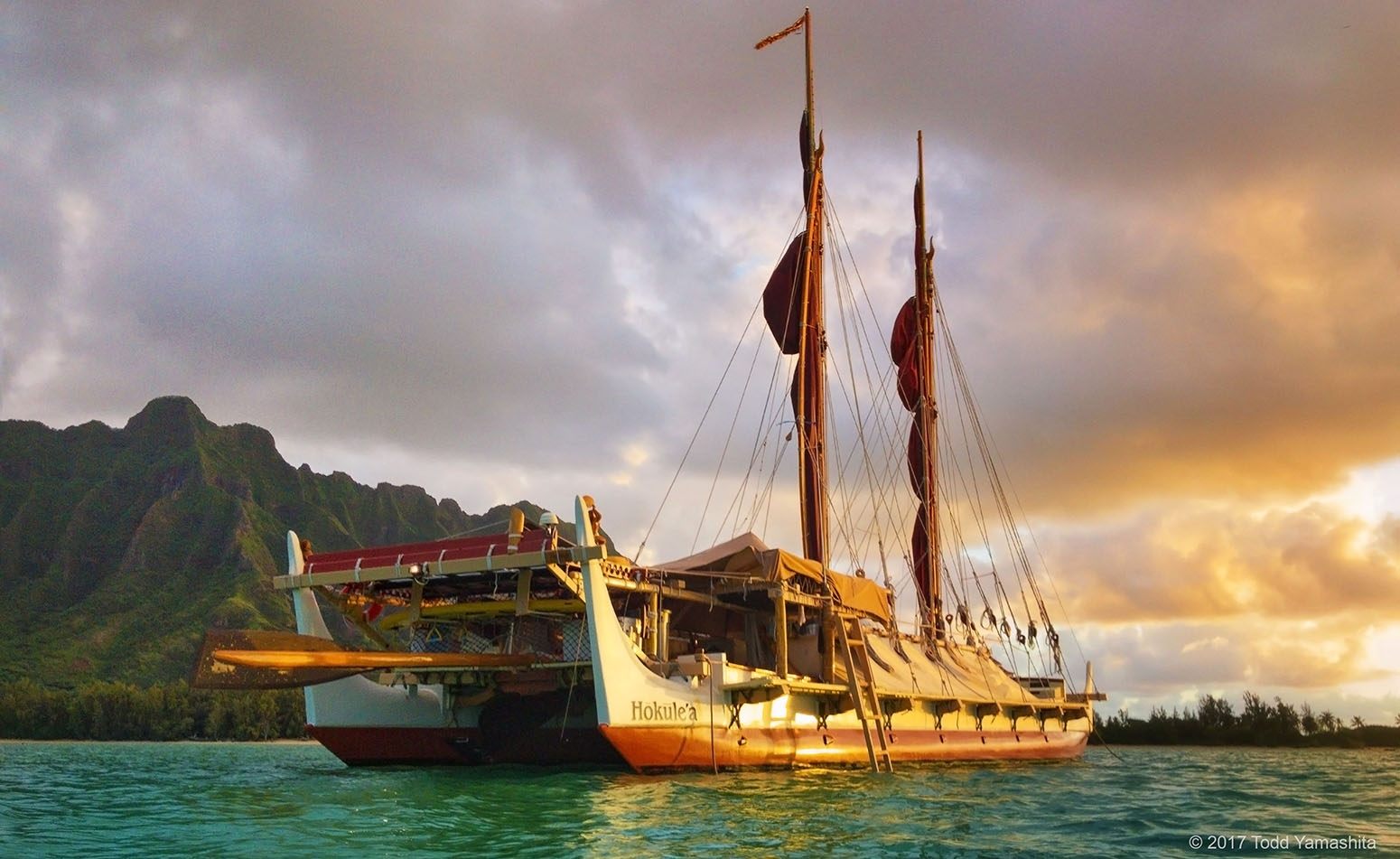
I’ve tried hard to devote serious attention in this blog to Indigenous boatbuilding and replica craft. And honestly, it hasn’t been difficult. Maritime Indigenous nations around the world have been using heritage boatbuilding as a celebration, as a chance to share skills, and sometimes to rediscover lost or endangered arts. One of the stellar examples of this is the Hōkūleʻa.
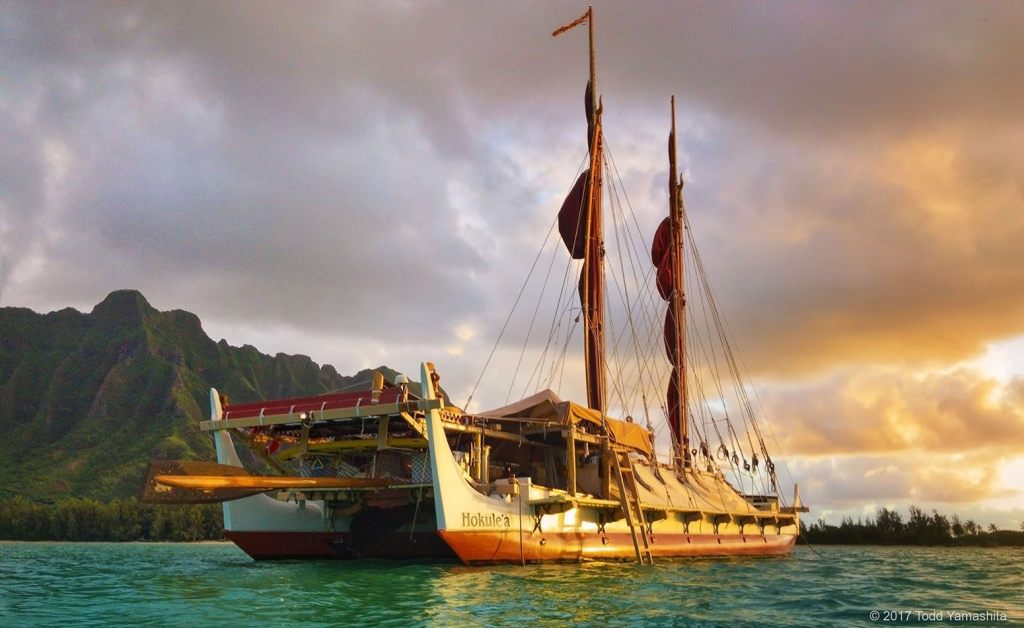
This “performance accurate” waʻa kaulua or double-hulled Polynesian ocean-going vessel was launched in 1975 and has been making historic voyages and training people in the Polynesian tradition of navigation for more nearly fifty years (As you’ll see below, the PVS use “performance accurate” as a term to describe their approach to authenticity).
The Polynesian Voyaging Society has used the success of Hōkūleʻa to build several other vessels, but I’m interested in spotlighting this particular vessel and its significance.
Specifications
| Class and type | wa’a kaulua |
| Tons burthen | 27,000 lb (12 t)[1] |
| Length | 62+1⁄3 ft (19.0 m) overall[1] |
| Beam | 17.5 ft (5.3 m)[1] |
| Draught | 2.5 ft (0.76 m)[1] |
| Propulsion | Sail |
| Sail plan | wa’a kaulua, crabclaw sails |
| Complement | 12 |
Benefits of the Build
In 1947, Thor Heyerdahl led the Kon-Tiki Expedition in a (bizarre but entertaining) attempt to gain credence for the subtly racist idea that Polynesia had been settled from the East by South Americans (led by bearded white men) floating upon currents. This was in contrast to prevailing thought among historians, archaeologists, linguists, Indigenous people, and others. It was typical of European attitudes (and continues to be) to be dismissive of Indigenous stories and skill.
So by the 1970s, it isn’t surprising to me that some Hawaiians wanted to challenge this and any other notion that imagined accident having anything to do with the amazing story of Polynesian expansion.
“Ben Finney pioneered the reconstruction and sailing of Polynesian voyaging canoes. He first began dreaming about building a canoe and sailing it to Tahiti while studying at the University of Hawai’i in 1958. In the mid-1960s he built Nalehia, a replica of a Hawaiian double canoe that provided the basic information on sailing performance that went into planning Hokule’a’s initial voyage to Tahiti…
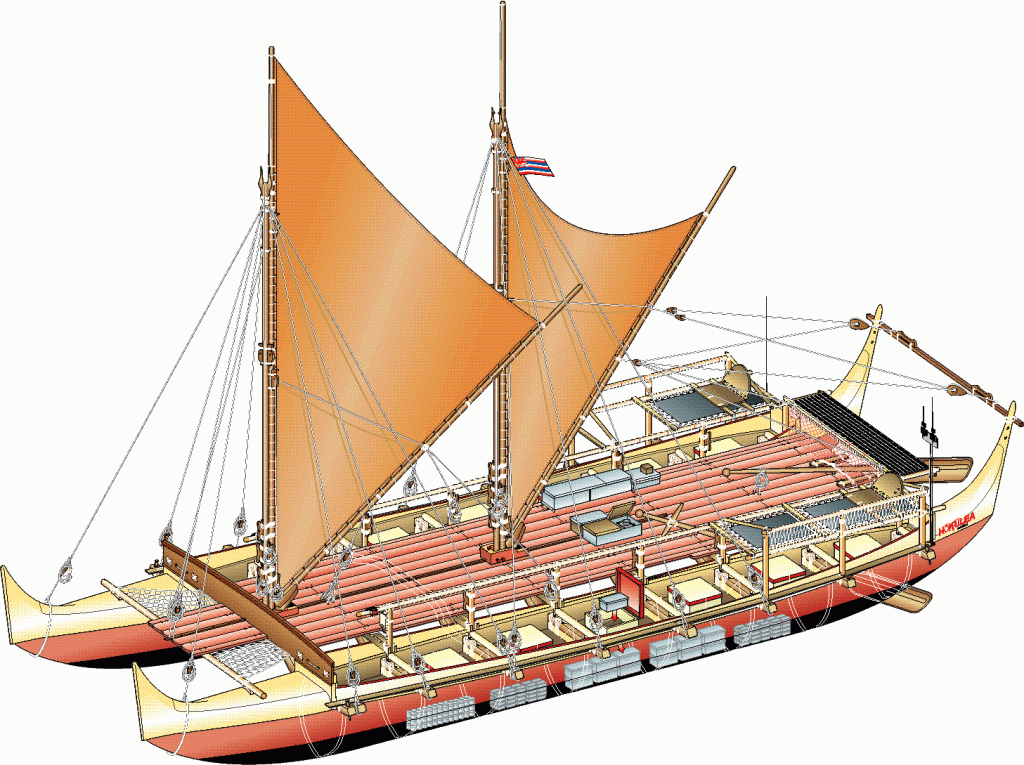
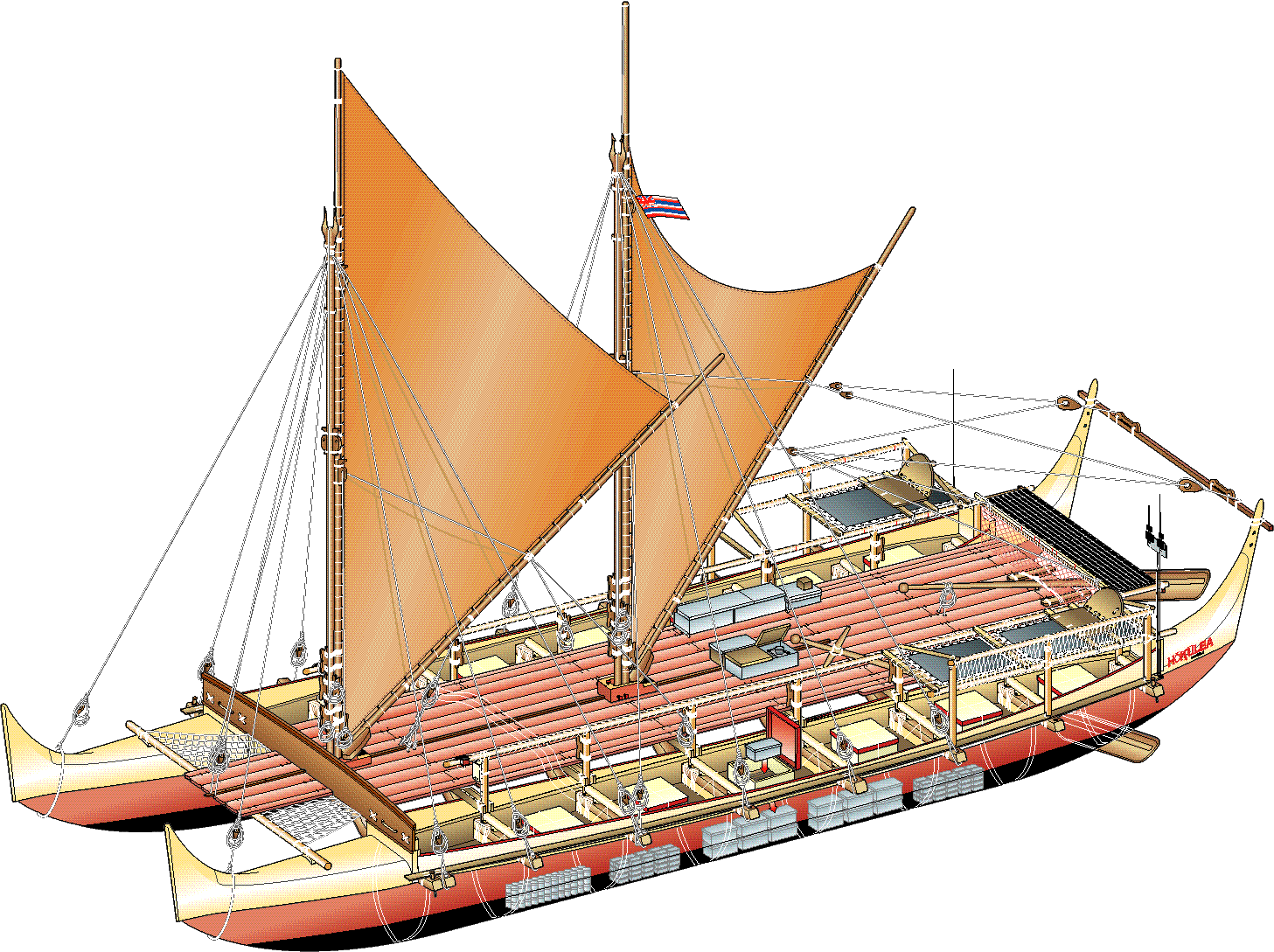
“Herb Kawainui Kane…came up with the conceptual design for the canoe, with Kenneth Emory…It has two 62-foot hulls; eight `iako, or crossbeams, joining the two hulls; pola, or decking, lashing to the crossbeams between the two hulls; rails along the decking; and two masts.” (Canoe Building, 2012).

“Since the ancient voyaging canoes and their navigators had disappeared from Polynesian waters, the obvious course was to experiment, to recreate the voyaging canoes and ways of navigating without instruments and then try them out at sea. In other words, the situation called for a nautical application of experimental archaeology, that branch of prehistory concerned with the reconstruction and testing of ancient artifacts and techniques.” (Finney)
After a few positive experiments, Finney, Kane, and others formed the Polynesian Voyaging Society in 1973 to raise funds for a build and a voyage.
I think it is important to note that Indigenous and non-Indigenous persons co-founded the Polynesian Voyaging Society, and it seems as if the latter used their privilege and abilities to help uplift the Hawaiian renaissance and other cultural revivals as supporters and allies. But to my mind, one of the hallmarks of the Indigenous character of the build was that it did not focus on rigid “authenticity. “
“We would have preferred to build our canoe using stone adzes, miles and miles of coconut fiber sennit line, and other features of traditional craftsmanship. But, beyond lashing some components of the canoe with sennit made for us on remote atolls where the old men still knew how to manufacture this cordage, and making an experimental sail out of strips of pandanus matting woven specially for us on the Polynesian Outlier of Kapingamarangi, we did not attempt to build the canoe with traditional materials and methods, for we knew that to try and recreate ancient tools and lost arts would have interminably delayed our project. Instead, we used some modern tools and materials, fabricating our hulls, for example, out of frames covered with layers of plywood strips, and then lashing the hulls, decking and other structures together mostly with modern line. However, we constantly strove to make our canoe in shape and weight a “performance accurate” replica of a traditional voyaging craft that would tell us much about how ancient canoes sailed. For example, despite numerous suggestions that we should widen the stance of the hulls to enable the canoe to carry more sail, add keel fins to the hulls to enhance their ability to resist leeway, and adopt a modern sail rig for greater speed, we stuck to traditional precedents of a narrow separation between hulls, a semi-rounded hull shape and the inverted-triangle sprit sail so that our canoe would sail no better than her ancient predecessors.
“We assembled the components of our canoe-two hulls each 62 feet in length, eight crossbeams, decking, rails and two masts-at Kualoa on the north shore of O’ahu Island. ” (Finney)
This isn’t the first, or the last time, we’ll see Indigenous boat-building projects reject an “authentic” approach of using solely traditional techniques and tools. Like all boat-building projects, they are restricted by time and budget. But since the goal of this build was the voyage and navigation, that is, the product, it was less important to build it in a wholly historical way. The tension between the product and the process is a continuing theme in all boatbuilding projects I’ve looked at.
I haven’t been able to find many photos of the vessel being built – perhaps similarly documenting the process wasn’t quite as important for the PVS as documenting the voyages.
Today traditional canoe-building is more prevalent, and the Friends of Hokule’a and Hawai’iloa have a wonderful video I wanted to share, even if the connection to Hōkūleʻa is a little tenuous.
Life After Launch
Hōkūleʻa was launched on 8 March 1975. It made its first voyage, to Tahiti, the next year. Besides attempting to prove an intentional Polynesian migration with advanced sailing and navigating techniques, the Polynesian Voyaging Society sought to revitalise and commemmorate Indigenous Hawaiian and Polynesian cultural crafts and skills.
The Polynesian Voyaging Society recruited the Satawalese Master Navigator Mau Piailug, one of a few remaining masters of traditional navigation – and reputedly the only one willing to share his knowledge with a new generation.
“The strategy of our navigator, Mau Pialug, was to use the rising points of the stars, supplemented by observations of the sun, moon, and ocean swells, as a natural compass to guide the canoe on its course. After mentally keeping track of our progress with a dead reckoning system which visualized the canoe in reference to the changing bearing of archipelagos to one side or the other of our course, Mau planned to make landfall on one of the atolls at the far western edge of the Tuamotu islands, and then make the short crossing from there to Tahiti.”

Books can and have been written about this first successful voyage and those afterwards. But suffice to say for the last forty years Hōkūleʻa has voyaged around the globe, training new navigators and others in traditional Polynesian maritime skills.

According to its website, Hōkūle‘a is moored at the Marine Education Training Center (METC) of Honolulu Community College in Honolulu Harbor, when not on a voyage.
Further Thoughts
According to a book by Jeff Evans , at least ten people from across the Pacific have been trained as navigators through the PVS programme. “They were given the status of master navigator by Mau through the Pwo ceremony, and went on to become an integral part of the renaissance of knowledge and traditions around voyaging.” The Pwo ceremony follows Indigenous traditions.
I recently watched the Disney film, Moana, and was struck by the similarity in the storyline to these real events. I’m not the only one. If you haven’t seen it, the titular character comes from an island people who have lost their navigating traditions and she, through contact with a traditional spiritual figure, or demi-god, learns and shares those skills.

The Polynesian Voyaging Society has gone on to build more boats and conduct more voyages. Hōkūle‘a even met Moomat Ahiko, a Californian Indigenous boat previously covered in this blog, during a recent visit to North America. They have emphasized meeting Indigenous peoples around the world and making connections to further goals of environmental stewardship and cultural renaissance.
The Polynesian Voyaging Society is a great example of how Indigenous peoples can commemorate, share skills, and build community using heritage watercraft. But since the purpose is the voyaging, it is the life after the launch – moreso than the build – that is emphasized.
Sources
Unattributed. “The Building of the Hōkūle’a – 1973–75″. Canoe Building. Polynesian Voyaging Society. Archived from the original on 18 September 2009. Retrieved 4 September 2012.
Finney, Ben. “Voyaging into Polynesia’s Past: The Founding of the Polynesian Voyaging Society” Polynesian Voyaging Society. Retrieved 5 December 2023.
N.B. I have resisted italicising the name of the Polynesian boats discussed here, due to not wanting to imply that Indigenous words are “foreign” when discussing their own country and their own practices. Mileage may vary and I’m happy to invite correction.
Clio’s Armada is a blog series Tom is writing based on his passion for heritage boatbuilding and examples he has seen of it around the world. Read about over twenty examples from the 1860s to the 2010s!
 North Wind Heritage Consulting
4 thoughts on “Clio’s Armada: Hōkūleʻa and the Polynesian Voyaging Society”