
The Ti’at Society of California built Moomat Ahiko, a ti’at canoe in the 1990s in the traditional manner of Indigenous peoples of what is now California. This type of vessel is unique in North America, having been called “…the single most technologically complex watercraft built in North America…”
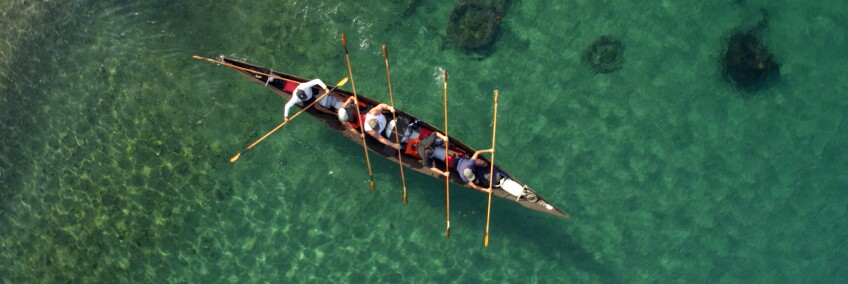
I saw a short documentary about this canoe on youtube and was fascinated. Not only was this a wonderful example of Indigenous approaches to crafts, but the canoe itself is so distinct, with its double-bladed kayak-like paddles and unique New World planking. Tomol and Ti’at are both appropriate words for this canoe, and their linguistic origins may come from Polynesian words. I originally understood tomol and ti’at to refer to the same vessel, but some reading has also suggested to me they are similar but not identical. Again, I don’t pretend to be an expert or this blog to be definitive.
Cindi Alvitre, a Tongva woman and Professor of American Indian Studies at Cal State University, had a literal dream and found meaning within it that inspired her towards this heritage boatbuilding project. Alvitre joined forces with Jim Noyes of the California Indigenous Maritime Association to form the Ti’at Society. (Case, 2015)
Ti’at canoes are flat bottomed and have no ballast, thus balance is important – which the rowers use to learn about inner balance. The stories around this heritage boatbuilding project are magical and full of lessons, overt and subtle, about Indigenous worldviews and practices. They’re also wonderful examples of how heritage crafts like this can create community and be transformative.
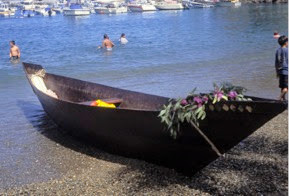
Specifications
Moomat Ahiko: 27ft
Baby Ti’at: 12ft
Benefits of the Build
Moomat Ahiko was built in the 1990s, although I wasn’t able to find a more precise date. It was launched in time to take part in the 1996 Ti’at Festival on Catalina Island. More recently the society took up a restoration and built a new “baby Ti’at” for a museum. Marcus Lopez, of the Chumash nation, is the canoe-maker in charge of that build as well as the restoration of Moomat Ahiko a few years ago.

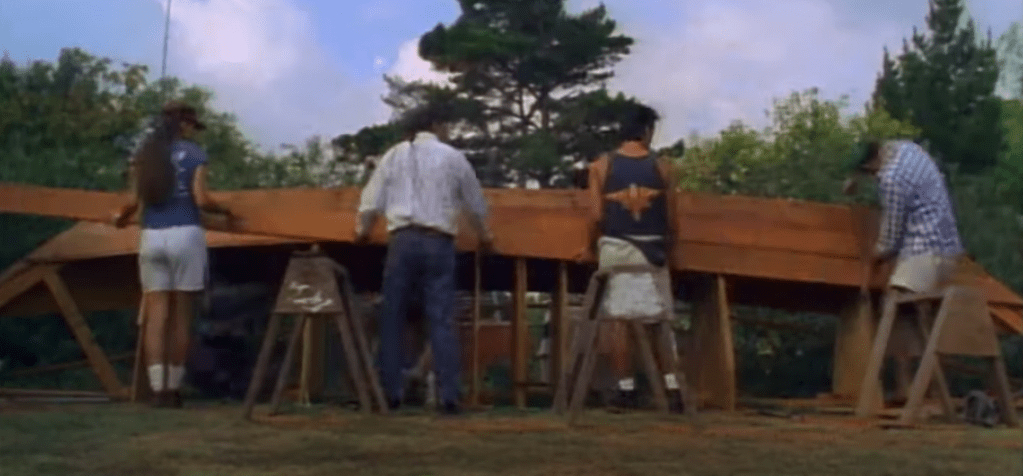
“The wooden boards of the ti’at are made of redwood logs split into planks. Traditionally, ti’at builders created planks from driftwood logs of redwood trees that washed down the California coast from northern California. For Moomat ahiko, the Ti’at Society worked with members of the Karuk Tribe in the Klamath River region to obtain the traditional redwood needed for the planks.” (Ludizinsky, 2019)
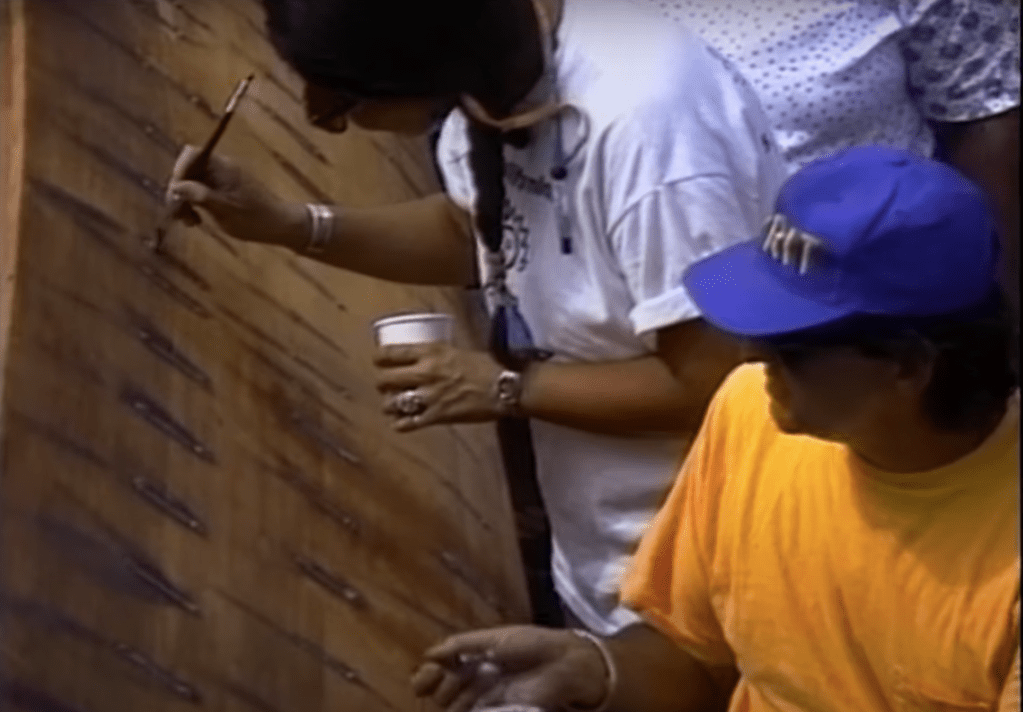
“The planks are bound with woven cordage made of plant fibers, including dogbane, nettle, sea grass, milkweed, or willow. Ti’at Society member Miztlayolxochitl Aguilera describes learning how to weave cordage from her uncle Craig Torres, and the patience it takes to ensure it is consistent all the way through.” (Ludizinsky, 2019)

Asphaltum, a naturally occurring tar was harvested, mixed with pine pitch and used as a sealant or caulking for the canoe planks over the sewn cordage.
“Building a plank-sewn boat requires a significant amount of skill and specialized engineering. All of the other watercraft on the west coast of North America were either tule balsas (bundles of dried reeds fashioned into canoes) or single-dug-out logs. The latter in some cases were very large, and could be used for ocean travel, but the techniques used to produce them are profoundly different than those used to build the sewn-plank canoe. The technological differences between the Chumash sewn-plank canoe, and the tule balsa used by their neighbors for 800 km (500 mi) to the north and south, seem significant. The tomolo was the single most technologically complex watercraft built in North America and it stands apart from all of the other Native boats of western North America. In truth, it stands out across all of the New World.” – Dr. Terry L. Jones, an archaeologist and Professor of Anthropology at the California Polytechnic State University (Quoted in Wiener, 2013)
While Moomat Ahiko is still intended for use, the “Baby Ti’at” built more recently for the state’s Natural History Museum is not. This beautiful canoe can now be used as an educational tool separate from the working boat. Building miniature versions of boats can help lessen the “price tag” for museums who have precious little space, both in storage and in display area.
True to Indigenous traditions, there was a sharing of teachings and a focus on relationships during the build. Harvesting rights were respected, and the redwood obtained by request to another nation and not fiat or retail purchase. Abalone inlay, traditional cordage weaving, and other practices were all shared. Food was brought and offered by those who wanted to learn. In this sense the build not only shared skills, but also created community.
You can watch more about the build of the “Baby Ti’at” here.
Life After Launch
According to Cal State University, “Since its conception, the Ti’At has succeeded in a variety of cultural voyages and village hops. Since the participation in the Ti’At Festivals in the island of Pimu (Catalina island), and participation at the Aquarium of the Pacific, International Music Festival, etc., the Moommat Ahiko has proven to be a sea worthy and cultural iconic vessel.”
Moomat Ahiko has appeared at pow-wows, and continues to be repaired and kept up so it can connect Indigenous Californians to their past. (Case, 2015).
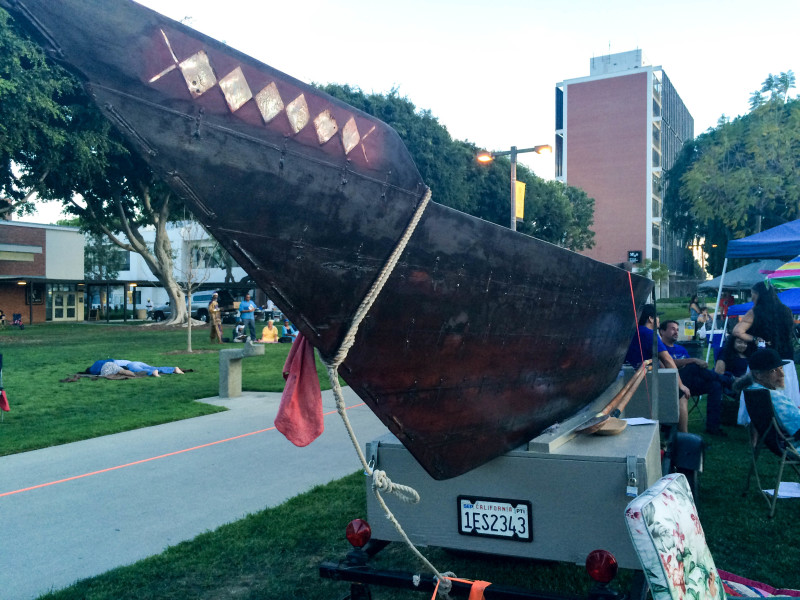
Moomat Ahiko is heavy, but light enough that a dozen rowers can lift and move her.
The Ti’at Society did not have a boathouse at the time of the documentary. They were adamant that the canoe had to be scrubbed down in such a way that it didn’t leach any chemicals into the water, and neither did it carry any from the ocean onto land.
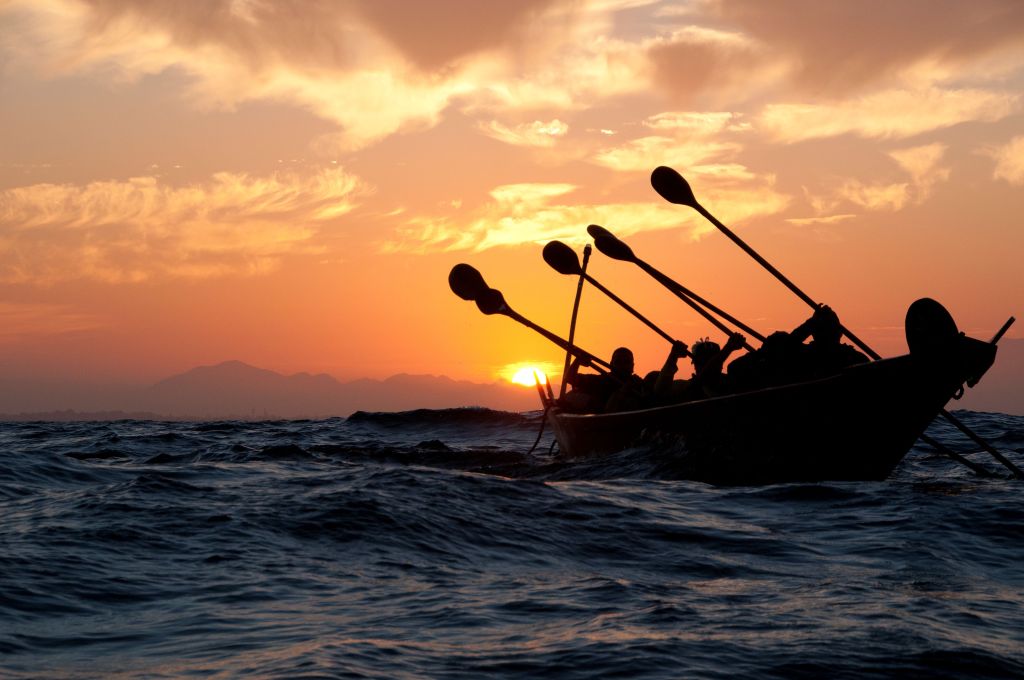
Moomat Ahiko is a rare example, but it is not unique. The building of tomol/ti’at continues, as do their use in annual pilgrimages and other ceremonies. In August of this year (2023) a rotating team of Chumash rowers paddled for 8 hours to reach he island of Limuw, also called Santa Cruz, in Channel Islands National Park. This annual crossing is a symbolic pilgrimage and represents the Chumash connection to their traditional homeland on the island.
Further Thoughts
Prof. Cindi Alvitre says on the documentary that rowing the ti’at is “…like traveling back in time, you’re doing the same thing your ancestors did.” What a wonderful encapsulation of the magic that can be had with reconstructed historical watercraft. (KCET, 2019)
The same documentary quotes Craig Torres, the cord-weaver from the Tongva nation, about how the build and the voyages provide opportunities to teach and reinforce Indigenous worldviews. Torres reminds us that everything has a spirit, and it is important to think about your relation to that spirit and the obligations you might have.
One of the other beautiful moments in this documentary involves a cross-cultural connection. The Ti’at society took Moomat Ahiko into the bay to meet Hōkūleʻa, a replica ship from the Polynesian Voyaging Society in a beautiful moment of connection. There is even some discussion of cross-pollination of sewn-plank canoe building, language, and other cultural exchange from Polynesian/Turtle Island connections. I plan to feature Hōkūleʻa and the Polynesian Voyaging Society in a future edition of this blog.
Overall the building of Moomat Ahiko and the “Baby Ti’at” showcase how heritage boatbuilding can build community, share heritage skills, and commemorate history. Professor Alvitre gave a lecture as recently as 2020 references philosopher Pierre Nora’s concept of lieu de mémoire (places of memory). “His study and philosophy says that memory is in the present. Such places of memory become the basis for social identity, constantly negotiated in the world.” (Quoted in the Catalina Islander).
What a perfect explanation as to why these builds hold so much power, and why keeping the replicas available to their communities is so important.
Sources
Case, Stephanie “Between Homelands: How a Canoe Connects a Tongva Woman to Her Tribe” The California Report, May 17, 2015. https://www.kqed.org/news/10524648/between-homelands-canoe-connects-a-tongva-woman-to-her-tribe
Laduzinsky , Paige “Traditional Boat Building Helps Native Community Hone Ecological Knowledge”. PBS Socal / KCET, 2019. https://www.pbssocal.org/shows/tending-nature/traditional-boat-building-helps-native-community-hone-ecological-knowledge
Wiener, James “Polynesians in California: Evidence for an Ancient Exchange?” World History et cetera, 2013.
Note: I chose not to italicise the name Moomat Ahiko so as not to place Indigenous words as “other” or “foreign.” I don’t imagine that anyone who does is doing so disrespectfully, but I have made my choice accordingly.
Clio’s Armada is a blog series Tom is writing based on his passion for heritage boatbuilding and examples he has seen of it around the world. Read about over twenty examples from the 1860s to the 2010s!
 North Wind Heritage Consulting
One thought on “Clio’s Armada: Moomat Ahiko and traditional Indigenous planked canoes”