
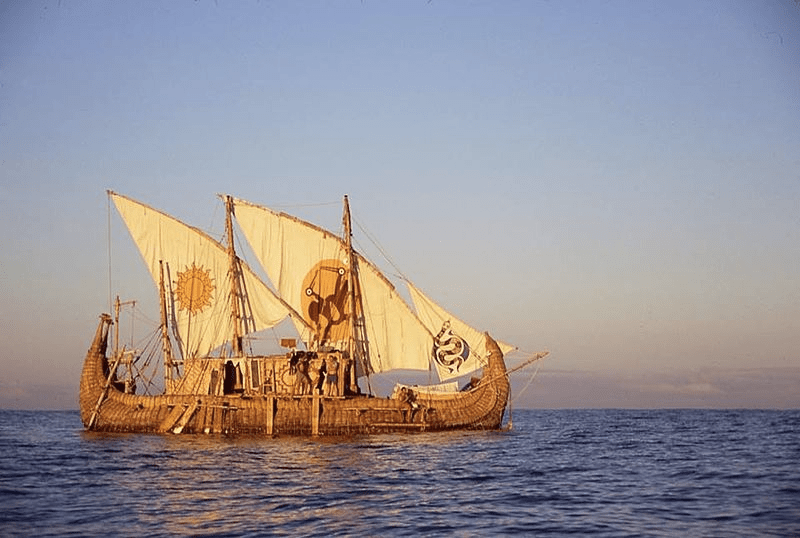
I’ve never seen any of the Viracocha rafts myself in person, but I did marvel at reed boats in Peru. When I heard about the Viracocha expeditions I read about them eagerly. I was as inspired by Kon-Tiki as most, and it seems that adventurer Phil Buck took it in an interesting direction.
Buck has led the building of three different iterations of a reed-based raft for pacific voyaging. The first two reached Easter Island from Chile, proving their seaworthiness, but he has been unable to reach Polynesia unassisted as was his goal. Viracocha I reached Easter Island in 2000, and Viracocha II did the same in 2003, although its actual goal was Polynesia. In 2018 Viracocha III got within 100 miles of Tahiti when the crew were forced to abandon ship.
Spanish adventurer Kitin Munoz has attempted similar feats in his Mata Rangi expeditions, also using reed boats (Heyerdahl’s original Kon-Tiki was of balsa wood). There are numerous other successor attempts in kon-tiki’s wake.
Specifications
LWL: 18.0m (60ft)
LOA: 22.5m (74ft)
Beam: 4.9m (16ft)
Weight(circa): 2,200kg (4,850lb)
Draught at launch: 1.0m (3ft 4in)
Draught after one week in the water: 1.25m (4ft 2in)
Crew: 8-12
(Sourced for Viracocha III here)
Benefits of the Build
I haven’t read a great deal of material about the build, but the Viracocha rafts were built by Indigenous Aymara craftsman from Lake Titicaca, where the reed boat tradition remains strong. The Limachi family have built boats for Heyerdahl (for his Egyptian expedition) and for Buck. Much like Heyerdahl’s expeditions, the Viracocha rafts use no metal or non-traditional materials (although there was some controversy in Viracocha II for synthetic rope use).
At the very least this build injected money into an Indigenous boatbuilding industry and thus contributed to making it sustainable. So many traditional skills are no longer economically viable and it is often the realm of museums and heritage sites to preserve them when the market cannot.
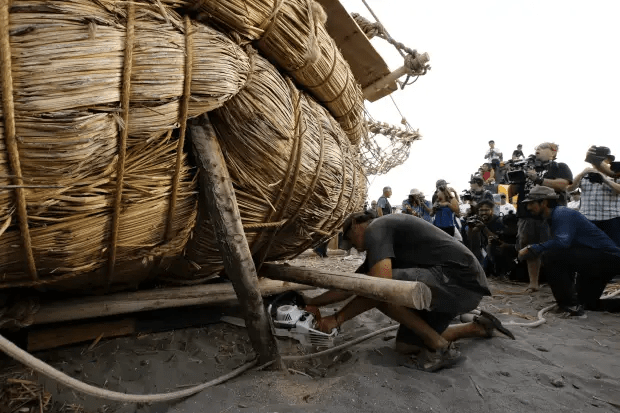
For those interested, the Wikipedia article contains a lengthy discussion of the craft. Meanwhile this Reuters article contains a beautiful series of photographs of the Indigenous boatbuilders at work. Plus there is a video!
Life after Launch
Viracocha III did not succeed in its prospective voyage and was abandoned at sea, 85 miles from Tahiti. While Buck’s vision and the crew’s bravery are to be lauded, it doesn’t seem likely that the Viracocha rafts will be preserved in a museum or otherwise commemorated.
Absolutely beautiful boat though.
Further Thoughts
We should ask: should the Viracocha rafts be preserved? This is a 21st century story, not really an ancient one. As far as I can tell, there is no real evidence that Indigenous South Americans were sailing reed boats such as this one on the Pacific. Certainly they could have, and that seems to be what Buck wanted to prove (though I think that seems secondary to the adventure of it).
There is certainly evidence that Polynesians and Indigenous South Americans had contact (potatoes, chickens, etc). (Source) But Polynesian boating re-enactments have tended to be successful at reaching North and South America, and the reverse doesn’t seem to be true. Please correct me if I’m wrong.
Heyerdahl’s story, which inspired Buck (and many others) is wonderful and inspiring, but also imbued with all sorts of questionable ideas about history and human movement as well as being dismissive of Polynesian boating traditions. He attributed Mesoamerican civilisation to bearded white people who then continued on to boat across the Pacific. Pretty racist. And contrary, even at that time, to prevailing understanding of human movement.
Actually having recently lived in New Zealand/Aotearoa I can testify that weird racist ideas of Celts (or others) having travelled there before the Maori continue to be popular despite little evidence, because they justify colonisation and erase Maori Indigeneity.
Regrettably I see this more and more as people seem to gravitate to conspiracy theories and outlandish explanations rather than respecting established expertise and the historical/archaeological process.
I don’t know enough about Phil Buck’s motivations to comment if he has the same problem. By using Indigenous Aymara boatbuilding techniques, it seems like he has made nods towards respect.
“I always seek projects that combine history, adventure, [and] exploration” he told Vice Video. The Viracocha projects certainly have aspects of history to them, but they don’t fit in to the same types of builds or voyages as many of the other heritage boatbuilding projects we will examine in this blog. That is not to say it is worth less, simply that it is a different type of build and voyage: mainly aiming towards adventure.
Sources
“Viracocha III: The Chilean reed boat built to sail across the Pacific” Yachting World, 2019. https://www.yachtingworld.com/extraordinary-boats/viracocha-iii-chilean-reed-boat-pacific-voyage-123954
Clio’s Armada is a blog series Tom is writing based on his passion for heritage boatbuilding and examples he has seen of it around the world. Read about over twenty examples from the 1860s to the 2010s!
 North Wind Heritage Consulting
